
2022: Industry Scrambles to Regain Footing
By Elizabeth West | August 24, 2025
The year 2022 marked a turbulent but pivotal chapter for the global business travel industry. Following the seismic disruptions of the COVID-19 pandemic, the sector faced a landscape transformed by new variants of the virus, persistent inflation, labor shortages, and evolving traveler expectations. As organizations and travel providers adapted to these challenges, industry stakeholders witnessed permanent shifts in travel demand, supply chains, and operational standards.
Pent-Up Demand Meets Inflation
As pandemic restrictions eased in early 2022, pent-up leisure and essential business travel surged. This supercharged demand, however, collided with strained supply chains and workforce shortages. According to U.S. Bureau of Transportation Statistics, average U.S. domestic airfares soared to $415 in Q2-Q4 2022—an increase of almost 40% from pandemic lows. Hotel rates climbed similarly, with the average daily rate (ADR) exceeding $148, up over 13% versus the previous high in 2019, and more than 43% from the depths of 2020.
Simultaneously, rampant inflation drove up costs for food, fuel, and wages across the supply chain. This forced airlines, hotels, and travel intermediaries to pass cost pressures onto travelers and corporate clients. Labor shortages plagued airlines and hospitality, hampering service and driving widespread dissatisfaction among travelers and travel managers alike.
Travel Management Woes and the Rise of SME Travel
As business travel resumed, travel management companies (TMCs) grappled with depleted workforces following large-scale layoffs and resignations during the pandemic. Recovery was marred by slow rehiring and increased complexity in travel policies—40% of business itineraries reportedly required agent service, compared to just 10% pre-pandemic. This stretched agents thin and led to elevated dissatisfaction among corporate buyers, prompting organizations to reassess their travel management partnerships.
Despite hesitance among large corporations to fully resume 2019 levels of transient business travel, small and midsize enterprises (SMEs) led the sector’s rebound. Industry leaders, like Accor CEO Sebastien Bazin, predicted international business travel volumes would remain permanently 20% below pre-pandemic levels—a view later reconsidered as new patterns emerged with strong SME momentum. For instance, major hotel groups and airlines adjusted strategies to actively court SME travelers, an often unmanaged demographic that proved quicker to return to in-person business.
Acquisitions and Investment Signal SME Focus
Key industry players pivoted toward this growth market. American Express Global Business Travel (Amex GBT) completed its acquisition of Egencia, targeting SME clients for managed travel services. Corporate Travel Management (CTM) and tech-driven newcomers like TravelPerk and Navan (then TripActions) aggressively expanded SME offerings through acquisitions and product innovation. Notably, Navan’s $300M investment round and TravelPerk’s $1.1B valuation highlighted continued confidence in technology-enabled, SME-focused travel solutions. Loyalty programs and streamlined onboarding became central tactics for attracting this critical segment.
Meetings, In-Person Collaboration, and the “Great Resignation”
Another consequential trend of 2022 was the resurgence of in-person meetings and events, especially among teams impacted by remote work. Companies sought to combat workforce isolation, collaboration gaps, and declining company loyalty—exacerbated by the “Great Resignation”—by organizing strategic offsites and smaller group meetings. As noted in industry surveys, planning windows shortened drastically due to persistent COVID-19 uncertainties, causing compression in available meeting space and driving rates even higher.
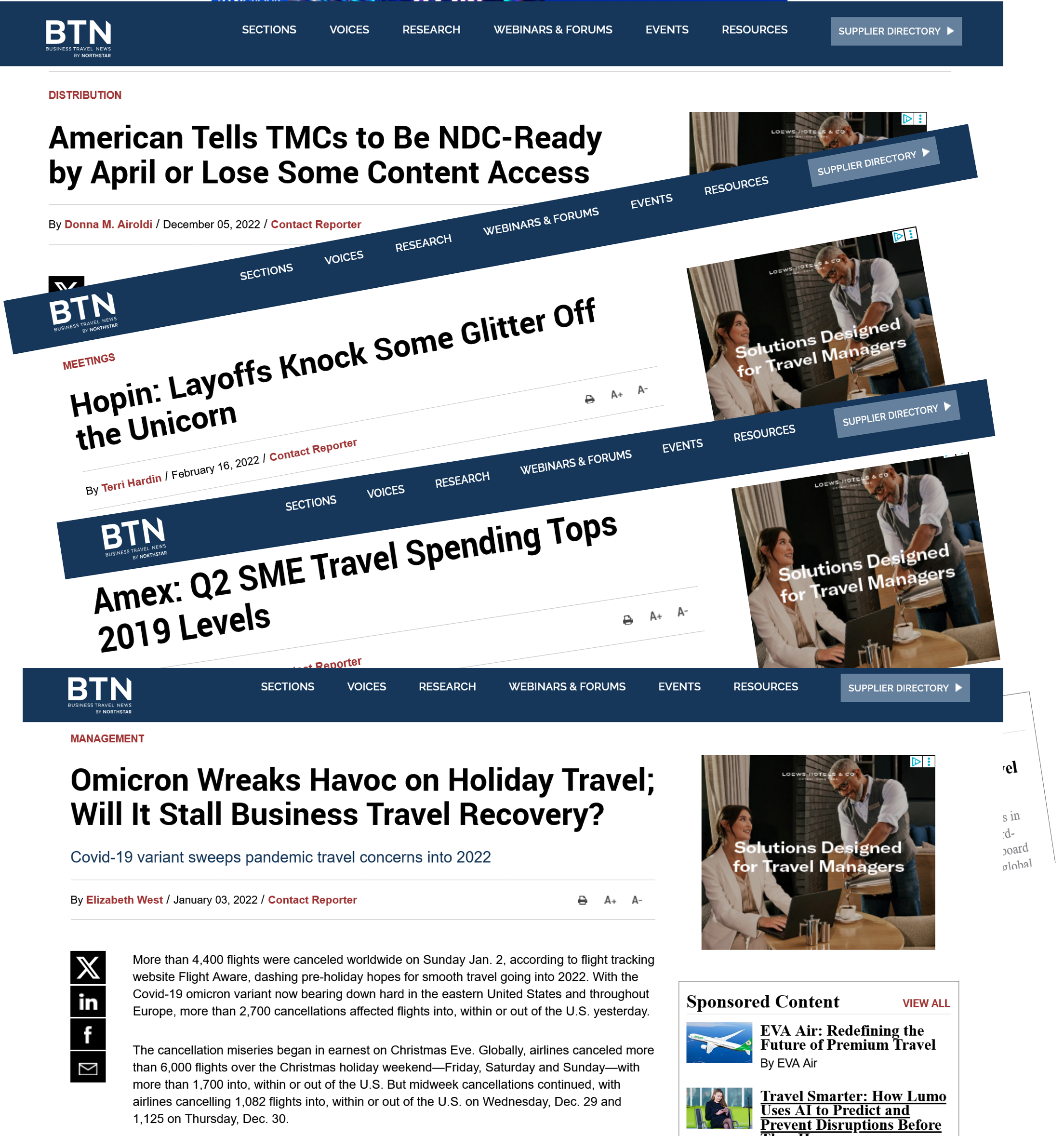
Hybrid meetings—featuring both in-person and virtual participation—remained a staple, but enthusiasm waned as corporations recognized the logistical and cost complexities of staging such events. Tech unicorns like Hopin, which had peaked in valuation amid virtual event demand, faced layoffs and declining user growth as companies gravitated back to face-to-face interaction.
Sustainability at the Forefront

As business travel volumes recovered, so too did a heightened focus on environmental sustainability. Travel suppliers, especially airlines, car rental companies, and TMCs, made bold pledges and investments across carbon reduction and emissions tracking. Industry standouts included:
- Hertz announced plans to purchase 100,000 Teslas, aiming for 20% of its fleet to be electric by 2024, and partnered with BP to expand the U.S. EV charging grid.
- Airlines like United, Southwest, Cathay Pacific, and JetBlue signed record deals for sustainable aviation fuel (SAF), while Shell, Amex GBT, and Accenture launched collaborative SAF certification and purchasing schemes for corporations.
- Reporting and measurement tools proliferated, with TMCs partnering with startups such as Thrust Carbon and Chooose to provide advanced carbon tracking for clients.
- The European Union advanced sustainability legislation with its Corporate Sustainability Reporting Directive, requiring greater transparency on business travel emissions data for large companies.
- The Biden Administration’s Inflation Reduction Act and infrastructure legislation injected new incentives for clean energy and transportation upgrades, although the landscape shifted with the 2024 U.S. presidential election.
Despite ambitious commitments, some high-profile sustainability efforts, such as Hertz’s large-scale EV acquisitions, would later be scaled back amid slower-than-expected adoption rates and economic headwinds.
Technology and Airline Distribution Disrupted
Perhaps the most dramatic shift in airline distribution occurred with American Airlines’ December 2022 announcement that it would pull 40% of its content from legacy EDIFACT channels, effective April 2023. Instead, agencies were required to connect via New Distribution Capability (NDC) platforms or risk losing access. This move, intended to streamline costs and drive innovation in retailing, drew significant backlash from agencies, many of whom struggled to meet the technical requirements by the deadline. The transition strained agent resources already consumed by customer service backlogs, and prompted some buyers to redirect their travel spend to competitors.
The broader push to NDC and direct connectivity continues to reverberate across global distribution systems, highlighting the travel industry’s ongoing digital transformation. Industry observers expect further realignment as airlines, TMCs, and technology providers refine their platforms for greater transparency, efficiency, and customer choice.
Separately, in November 2022, OpenAI introduced ChatGPT. While its impact on business travel was not immediate, the subsequent rise of artificial intelligence is already shaping online booking, customer support, data analytics, and risk management functions throughout the sector.
Looking Forward
The events of 2022 forced business travel decision-makers to confront a new normal characterized by agile adaptation, digital transformation, complicating labor markets, and relentless pressure for environmental responsibility. While not all pandemic scars have faded, the sector’s return to stability—albeit with a changed workforce and traveler base—affirmed the continued importance of meaningful, in-person business connections in a digitizing, divided world.
Read the full archive and related sustainability highlights.


