
Nvidia CEO Jensen Huang Predicts OpenAI as the Next Multi-Trillion-Dollar Giant
Published: Sep 28, 2025 | By: TOI Tech Desk
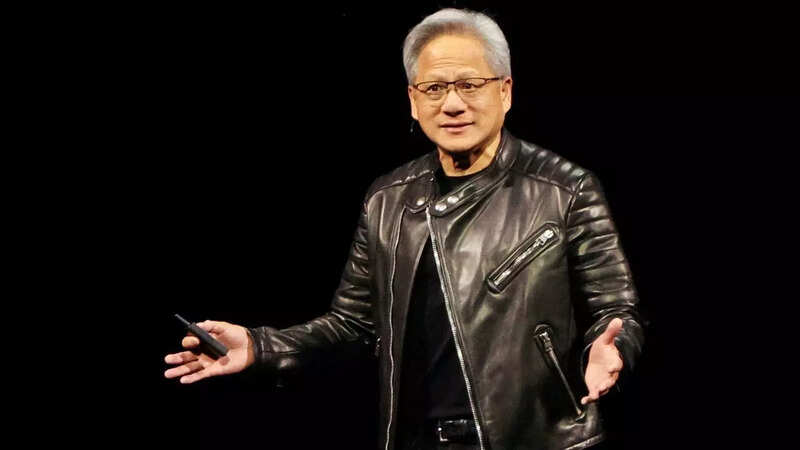
Nvidia CEO Jensen Huang, one of the most influential figures in the artificial intelligence (AI) and semiconductor industries, has put forth a bold prediction: that OpenAI, backed by Microsoft, could soon become the next multi-trillion-dollar company—a status now reserved for the likes of Google, Meta (Facebook), Apple, and Microsoft itself. In a recent appearance on the BG2 podcast, Huang underscored the unprecedented scaling potential and disruptive force of OpenAI in both consumer and enterprise markets.
OpenAI: The Next Hyperscale Tech Titan?
Huang commented, “I think that OpenAI is likely going to be the next multi-trillion dollar hyperscale company. They’re going to have consumer and enterprise services. If that’s the case, the opportunity to invest before they get there is one of the smartest investments we can possibly imagine.” Huang’s comments reflect widespread industry expectations about OpenAI, whose flagship products—such as ChatGPT, DALL-E, and Codex—have brought generative AI into the mainstream and pushed the boundaries of automation, search, and creative applications.
According to data from CB Insights, OpenAI’s valuation soared to roughly $86 billion in a recent private share sale, even eclipsing titans like Stripe and SpaceX among non-publicly-traded companies. The company, founded in 2015, reported annualized revenues exceeding $2 billion as of mid-2024, and it continues to attract massive interest from both enterprise clients and investors.
Deepening Partnerships: Nvidia’s Strategic Edge
Nvidia’s own fortunes have soared due to its dominant position in high-performance GPUs essential for AI model training and deployment. As AI workloads have rapidly increased in scale and complexity, Nvidia chips have become the backbone of modern data centers, and Huang detailed that Nvidia is now working with OpenAI on multiple infrastructural fronts:
- Microsoft Azure AI Buildout: OpenAI’s close relationship with Microsoft Azure has led to the construction of vast AI supercomputing infrastructure, powered largely by Nvidia’s latest GPUs, such as the H100 and the next-generation Blackwell architecture.
- Oracle Cloud Infrastructure (OCI): Nvidia, along with OpenAI and SoftBank, is also engaged in the deployment of massive GPU-powered clusters—up to several gigawatts of compute—in Oracle’s cloud.
- CoreWeave: Nvidia and OpenAI are working with hyperscale GPU cloud provider CoreWeave to accelerate model development and broaden the reach of generative AI applications.
- OpenAI’s Self-Built Infrastructure: For the first time, OpenAI is building and operating its own dedicated AI infrastructure. Nvidia is supporting this evolution by co-designing and supplying advanced systems at every technology level, from individual chips and servers up to entire AI factories.
Exponentials and AI Market Boom
According to Huang, OpenAI—and its competitors—are experiencing not just linear but exponential growth on two fronts:
- Customer Adoption: As AI models become more versatile and accessible, brands of all sizes are integrating OpenAI-powered tools for chatbots, creative content, programming, and automation—expanding the addressable market dramatically.
- Computational Demand: With the evolution of generative AI (from simple inference to complex multi-step reasoning and task execution), the required compute has soared. OpenAI’s upcoming models, such as GPT-5, are expected to require even more intensive hardware investment and innovation.
This compounded growth is driving an “arms race” in infrastructure spending. Recent industry estimates project that the global AI hardware market will reach $400 billion annually by 2027, as data centers become even more central to cloud computing—and Nvidia remains the principal supplier of the chips at the heart of it all.
OpenAI, Microsoft, and the Industry Landscape
The AI landscape continues to evolve rapidly, with OpenAI and Microsoft leading the pack in generative AI research and deployment. Microsoft’s multi-billion-dollar investment in OpenAI—for both equity and cloud credits—has solidified a symbiotic relationship, with OpenAI models powering Bing, Microsoft Copilot, and soon, enterprise-optimized agents.
Other industry giants, including Google (with DeepMind and Gemini) and Meta (with Llama and other foundational models), are in fierce competition to capture share of the burgeoning AI market. According to IDC, global spending on AI-centric systems is projected to surpass $300 billion by 2026, reflecting uncontested momentum.
The Investment Case for AI Giants
For investors and strategic partners, Huang argues that backing OpenAI now, before an eventual public offering or further valuation surge, represents a generational opportunity. Many venture funds and sovereign wealth funds are actively seeking a stake, though OpenAI’s structure and limitations on outside capital have constrained supply and fueled secondary market trading.
Looking Ahead: Direct Partnerships and Industry Shifts
As OpenAI grows, Huang anticipates its relationship with Nvidia will intensify, resembling Nvidia’s direct engagement with other hyperscalers like Meta, Google, and X. “They want to have a relationship with us the way Elon and X has,” said Huang, referring to bespoke hardware and software development tailored to supercharge AI research and productization at massive scales.
The announcement of OpenAI’s move to “self-build” AI infrastructure signals a strategic shift: from exclusive reliance on public cloud providers to a hybrid model of direct technology integration. Industry analysts suggest this could help OpenAI reduce costs, increase customization, and accelerate the rapid release cycles necessary to remain at the forefront.
Conclusion: An Era of AI Titans
Jensen Huang’s forecast of OpenAI as the world’s next multi-trillion-dollar enterprise is more than just optimism—it echoes the consensus among tech leaders, investors, and engineers that we are at the dawn of a new technological epoch. As generative AI reshapes industries from healthcare and finance to media and customer service, and as infrastructure requirements explode, the strategic partnership between Nvidia and OpenAI is poised to redefine not just markets, but the possibilities of artificial intelligence itself.
For the full BG2 podcast with Jensen Huang, watch here.


