
Chevron-Hess Mega-Merger Redefines Global Oil Power Balance
Published: July 21, 2025 — Casey Merriman (Phoenix) & Marc Roussot (Houston), Edited by James Bourne

Deal Completion and Strategic Victory
After 19 months of painstaking negotiations and legal wrangling, Chevron has successfully closed its landmark $55 billion purchase of Hess Corporation. The deal, finalized on July 18, 2025, brings to an end a prolonged saga highlighted by a high-stakes arbitration battle with ExxonMobil. Exxon’s bid to enforce preemption rights over Hess’s prized assets in Guyana was ultimately rejected by the International Chamber of Commerce, clearing the way for Chevron to move forward with its largest acquisition in two decades.
This transaction is among the most significant oil industry mergers in the last ten years, surpassing many recent deals in both value and strategic impact. The merger enhances Chevron’s competitive position amid intensifying resource nationalism and a global energy transition marked by the persistent importance of oil and gas, despite increasing investment in renewable sources.
Securing Place Among Global Giants
Chevron’s successful integration of Hess cements its hold as one of the globe’s top oil and gas producers. Along with ExxonMobil—who also executed a $64.5 billion acquisition of Pioneer Natural Resources in 2024—the two US supermajors have underlined their long-term bet on sustained global fossil fuel demand. According to Energy Intelligence’s Top 100 Global NOC and IOC Rankings, Chevron now stands sixth worldwide, just behind ExxonMobil at fifth—both trailing only massive state-owned companies like Saudi Aramco, National Iranian Oil Company (NIOC), China National Petroleum Corporation (CNPC), and Rosneft. This strategic move further widens the gap between US oil majors and their European peers, who have been more aggressive in shifting towards renewables and divesting legacy assets.
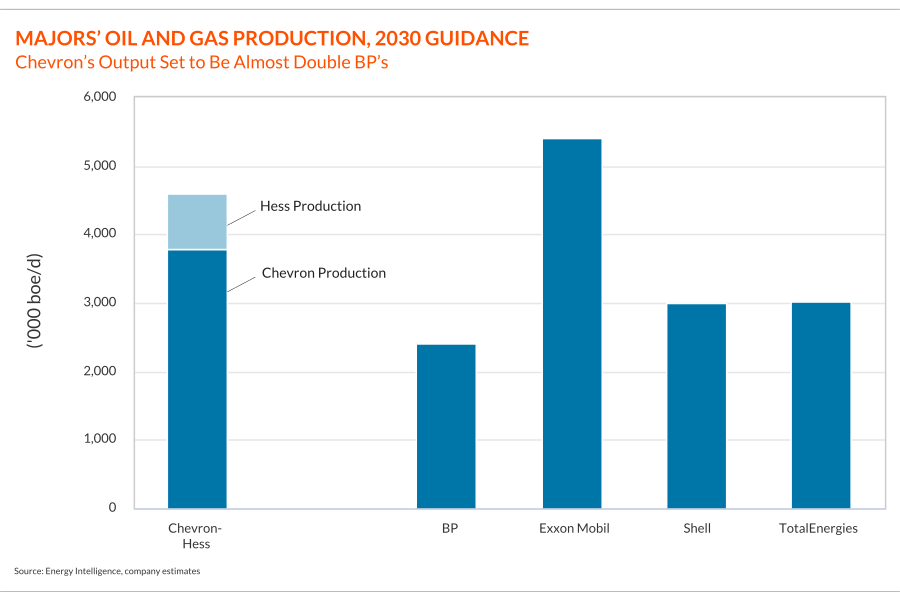
Industry estimates project Chevron’s production will approach 4.6 million barrels of oil equivalent per day (boe/d) by 2030, compared to about 5.4 million boe/d for Exxon. Meanwhile, leading European competitors—Shell, BP, and TotalEnergies—are expected to remain capped near the 3 million boe/d mark. This signals increasing American dominance in upstream oil production, especially as European consolidation rumors swirl but remain unrealized as of mid-2025.
Chevron CEO Mike Wirth highlighted the merger’s transformative impact: “This combination enhances and extends our growth profile well into the next decade, driving greater long-term value to shareholders.”
Guyana: The Crown Jewel
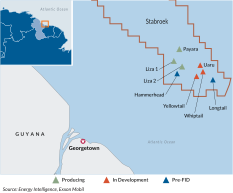
The heart of this merger is Hess’s 30% stake in the Stabroek Block offshore Guyana, now recognized as one of the world’s most promising new oil frontiers. Operated by ExxonMobil—with CNOOC holding a 25% stake—the Stabroek Block has consistently exceeded production forecasts. Originally, plans targeted 1.3 million barrels per day of nameplate capacity by 2027. Since then, projections have swelled: ExxonMobil now expects capacity to reach 1.7 million b/d by 2030, with new floating production, storage, and offloading (FPSO) vessels like Hammerhead and Longtail scheduled for imminent development. Just in Q4 2024, the first three FPSOs ran at 650,000 b/d—well above their combined nameplate capacity of 560,000 b/d, underlining exceptional field performance.
The resource base is equally impressive. While ExxonMobil officially estimates around 11 billion barrels of oil equivalent in recoverable resources, Hess’s leaders believe the reserve base could be substantially larger, suggesting the potential for even higher peak production and a more resilient output plateau into the next decade. This prospect positions Chevron to capitalize on one of the few places globally where oil output continues to rise amid otherwise maturing or declining basins.
Deal Value and Changing Market Dynamics
Despite rising resource optimism in Guyana, Chevron’s final deal was completed at an 8% discount to its original $60 billion all-in value (including debt) due to declines in Hess’s share price during the extended arbitration process. The share-based structure helped insulate Chevron from having to raise new debt or deploy cash, but it increased shares outstanding by 17%—a key focus for investors, who have otherwise watched Chevron’s aggressive share buyback reduce its share count by 10% in the prior two years.
Investor confidence was subdued as legal uncertainty persisted, with Chevron’s shares trading at a 12% discount to ExxonMobil during the dispute (per Citi data). Now, with the ICC resolving the dispute definitively in Chevron’s favor, analysts anticipate a rapid reassessment of Chevron’s market value. The company has already made moves to reduce share dilution, preemptively buying back 5% of Hess’s shares in anticipation of a successful outcome.
M&A Strategy, Divestments, and Portfolio Realignment
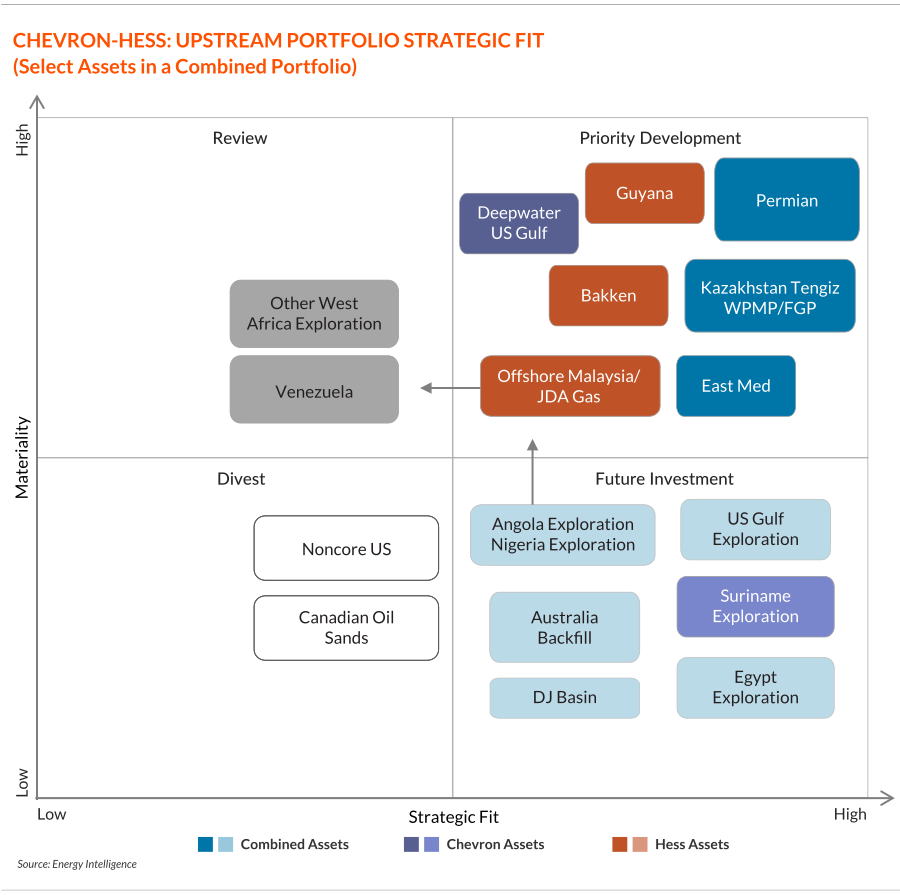
Unlike many major acquirers, Chevron has not announced any immediate asset divestments following the Hess acquisition. However, industry watchers point to Hess’s upstream assets in Malaysia and Thailand as likely candidates for review or potential sale. Chevron has been trimming its Southeast Asian presence, having exited Indonesia in 2023 and reduced Thai production following the end of the Erawan concession. Nevertheless, the acquired North Malay Basin and offshore Malaysia-Thailand Joint Development Area together provide Chevron with 57,000 boe/d of mostly gas output serving local demand. These projects, however, face challenges related to above-average carbon intensity—at a time when Chevron is emphasizing lower-carbon growth.
The company has not featured these Southeast Asian assets in its post-merger communications or asset maps, underscoring their peripheral nature to Chevron’s global strategy. A disposal could further streamline Chevron’s portfolio and help finance share repurchases or additional capital programs.
Looking Ahead: Integration and Investor Expectations
Chevron is now focused on integrating Hess and unlocking the anticipated synergies—ranging from operational efficiencies to enhanced capital allocation. Key upcoming events include Chevron’s second quarter earnings report on August 1 and the rescheduled Capital Markets Day in November, where investors expect more clarity on future buyback plans and growth strategy.
Comparisons will be drawn to ExxonMobil’s rapid repurchase of a third of its newly issued shares after the Pioneer merger, suggesting that Chevron may embark on an accelerated buyback program of its own, likely exceeding its current $10–12 billion annual run rate.
Ultimately, the Chevron-Hess deal reaffirms the centrality of scale, resource depth, and disciplined capital management in the turbulent global energy sector. By anchoring its strategy in high-growth, low-cost regions like Guyana and leveraging its robust balance sheet, Chevron is better positioned to weather market cycles and emerging regulatory pressures—making this merger a defining moment for the next era of oil majors.


