
Trump’s New Tariffs on India: The Next Flashpoint in Global Trade
By BBC News – June 2025
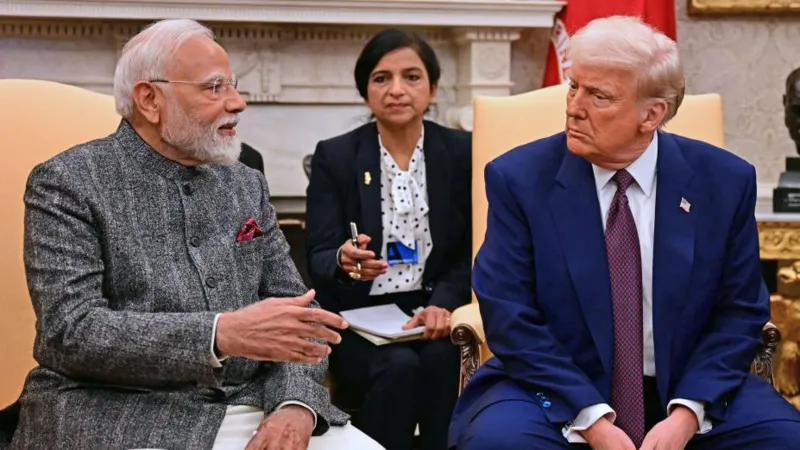
Introduction: Tensions Rise in US-India Trade Relations
In a recent announcement that sent ripples through international markets, US President Donald Trump stated that India could soon face tariffs as high as 25% on a broad range of exports to the United States. The warning comes amid stalled trade negotiations between the two countries, with agriculture and digital commerce representing significant obstacles. As the world’s largest and fifth-largest economies spar over tariffs, the repercussions are expected to stretch from global supply chains to consumer wallets.
Background: Escalation in US Tariff Policy
Since his return to office, President Trump has re-emphasized his “America First” trade doctrine. Previous rounds of tariffs on China and the European Union have marked a new era of protectionist economic policy. Now, India finds itself in the crosshairs, with the Trump administration citing longstanding grievances over market access, intellectual property, and what US officials argue are unfair barriers to American agricultural and technology exports.
US-India trade has traditionally been robust, with two-way goods and services trade reaching an estimated $192 billion in 2023, according to the Office of the US Trade Representative. Yet, the US trade deficit with India – around $29.3 billion in 2023 – remains a sore point for the Trump administration, which continues to push for a more “balanced” relationship.
The Sticking Points: Agriculture and Digital Commerce
At the heart of the ongoing disputes are disagreements over agricultural imports and digital commerce policies. US officials have pressed India to allow greater imports of American agricultural products, including dairy, poultry, and nuts. India, insisting on protecting its millions of smallholder farmers and food security, has resisted these demands.
Digital commerce is another contentious area. India’s data localization rules and restrictions on foreign e-commerce giants like Amazon and Walmart-owned Flipkart have drawn criticism from US policymakers and businesses, who argue these measures unfairly limit market access and innovation. New tariffs could escalate these tech tensions, as India is a significant global provider of IT services and back-office support.
Economic and Global Impact
The potential imposition of tariffs as steep as 25% has major ramifications. India is a key exporter of textiles, pharmaceuticals, gems, and information technology services to the US. American companies, ranging from apparel retailers to pharmaceutical distributors, could see sharp increases in their supply costs and face pressure to find alternative suppliers.
For India, the prospect of new tariffs threatens to dampen export growth at a time when its economy is just recovering from several global shocks, from the COVID-19 pandemic to disruptions triggered by the Russia-Ukraine conflict. According to the Federation of Indian Export Organisations, the new tariffs could jeopardize tens of billions of dollars in exports and potentially impact hundreds of thousands of jobs in labor-intensive sectors.
The World Trade Organization (WTO) and the International Monetary Fund (IMF) have both warned that further trade restrictions could have a chilling effect on global economic growth. “Trade tensions, particularly those involving major economies, remain a significant risk to the global outlook,” said IMF Managing Director Kristalina Georgieva in a recent press briefing.
Political Calculus in the US and India
Domestic political pressures are influencing both sides. For Trump, projecting toughness on trade remains a rallying point among his political base, while also leveraging trade deals to win electoral support in key agricultural and manufacturing states. The announcement of tariffs coincides with recent US midterm election campaigns, where trade is a potent issue.
On the Indian side, Prime Minister Narendra Modi faces his own complex balancing act. India’s vibrant export sectors and fast-growing tech industry are critical to his economic agenda, yet protection of domestic agriculture remains politically sensitive, given the sector’s role as the country’s largest employer.
Commenting on the situation, Dr. Aparna Singh, a trade policy analyst at Jawaharlal Nehru University, notes: “While both leaders need to be seen as defending national interests, the economic reality is that sustained tariffs could damage both economies and undermine global trust in rules-based trade.”
Business and Market Reactions
Wall Street and Indian stock markets have responded with notable volatility since the announcement. Many US multi-nationals with deep ties to the Indian market—such as Apple, Walmart, and Pfizer—have urged both administrations to resume talks and prevent escalation. The US-India Business Council, in a statement, warned that a tit-for-tat tariff battle could disrupt global supply chains and diminish investor confidence at a time when the world economy remains precariously balanced.
Indian exporters, already under pressure from rising input costs and logistical bottlenecks, fear losing market share to competitors from Vietnam, Bangladesh, and Mexico, who may not be subject to new tariffs.
Outlook: What Happens Next?
Trade negotiators from both nations continue to meet in an effort to stave off an all-out tariff war. However, as of June 2025, no breakthrough has been announced. Observers expect months of talks, during which time industries from textiles to technology brace for potential disruption.
Meanwhile, the US administration has left the door open to tariff exemptions for certain sectors if “meaningful progress” is made. The resolution of this dispute has far-reaching implications not just for the two countries, but for the future of global trade. As the US and India navigate their complex relationship, businesses and consumers worldwide will be watching closely.


