
Bitcoin Surges Past $119,000 Amid U.S. Government Shutdown; Crypto Markets Rally, Option Strategies Gain Interest
Published: October 2, 2025
By: Omkar Godbole

Bitcoin Rockets to Highest Level in 2025
The world’s largest cryptocurrency, Bitcoin (BTC), blasted past $119,000 for the first time since mid-August, invigorated by a perfect storm of market catalysts. With the U.S. federal government shuttering operations on October 1, 2025 amid congressional deadlock, traders anticipated new liquidity measures and Federal Reserve easing that could further boost Bitcoin’s appeal as a macro hedge.
According to CoinDesk data, BTC rose nearly 4% in 24 hours, briefly peaking at $119,455. The rally wasn’t isolated—major altcoins such as Ethereum (ETH), XRP, and Solana (SOL) also posted significant gains of 4% to 7%. The CoinDesk 20 Index climbed 5% to 4,217 points, reflecting broad-based enthusiasm across the crypto sector.

Government Shutdown Spurs Liquidity Expectations
The recent government shutdown, triggered by failed budget negotiations in Congress, could delay the release of key U.S. economic data—most notably, the Bureau of Labor Statistics’ monthly jobs report. The absence of this data increases uncertainty around the Federal Reserve’s policy outlook, forcing markets to price in a higher probability of interest rate cuts and possible adjustments to quantitative tightening.
Matt Mena, Crypto Research Strategist at 21Shares, explained, “If the ADP private payrolls report signals labor market weakness and the Bureau of Labor Statistics report is delayed, the Fed could cut rates as soon as October. A liquidity impulse from easier monetary policy typically supports risk assets like Bitcoin.”
The ADP’s recent private payrolls report showed lackluster job growth, adding to speculation that the central bank will ease policy. The Fed already slashed rates by 25 basis points last month and indicated a dovish stance for the remainder of 2025.
Historically, Bitcoin has outperformed during periods of low real interest rates and rising liquidity. The prospect of further policy easing and a softening U.S. dollar is pushing investors toward digital assets as a store of value and inflation hedge. Mena noted, “Bitcoin’s rally following the shutdown could signal the start of an explosive leg higher as traditional economic indicators go dark and macro uncertainty mounts.”
BTC Options: Cheap and Ready for Volatility
The surge in BTC’s price has also revived interest in derivatives markets. According to Greg Magadini, Director of Derivatives at Amberdata, options on BTC listed at Deribit are currently “cheap” due to a prolonged dry spell in volatility. “The U.S. shutdown may finally be the catalyst that triggers major price swings,” Magadini said, highlighting that the implied volatility (IV) term structure is in steep contango—future-dated options are much pricier than near-term ones.
This setup makes near-term options especially attractive. Savvy traders are eyeing long straddle strategies—simultaneously buying call and put options—to profit from outsized moves in either direction. “With the USD responding to shutdown and jobs data uncertainty, options allow investors to hedge risk while gaining exposure to explosive price action,” Magadini added.
ETF Inflows and Mainstream Momentum
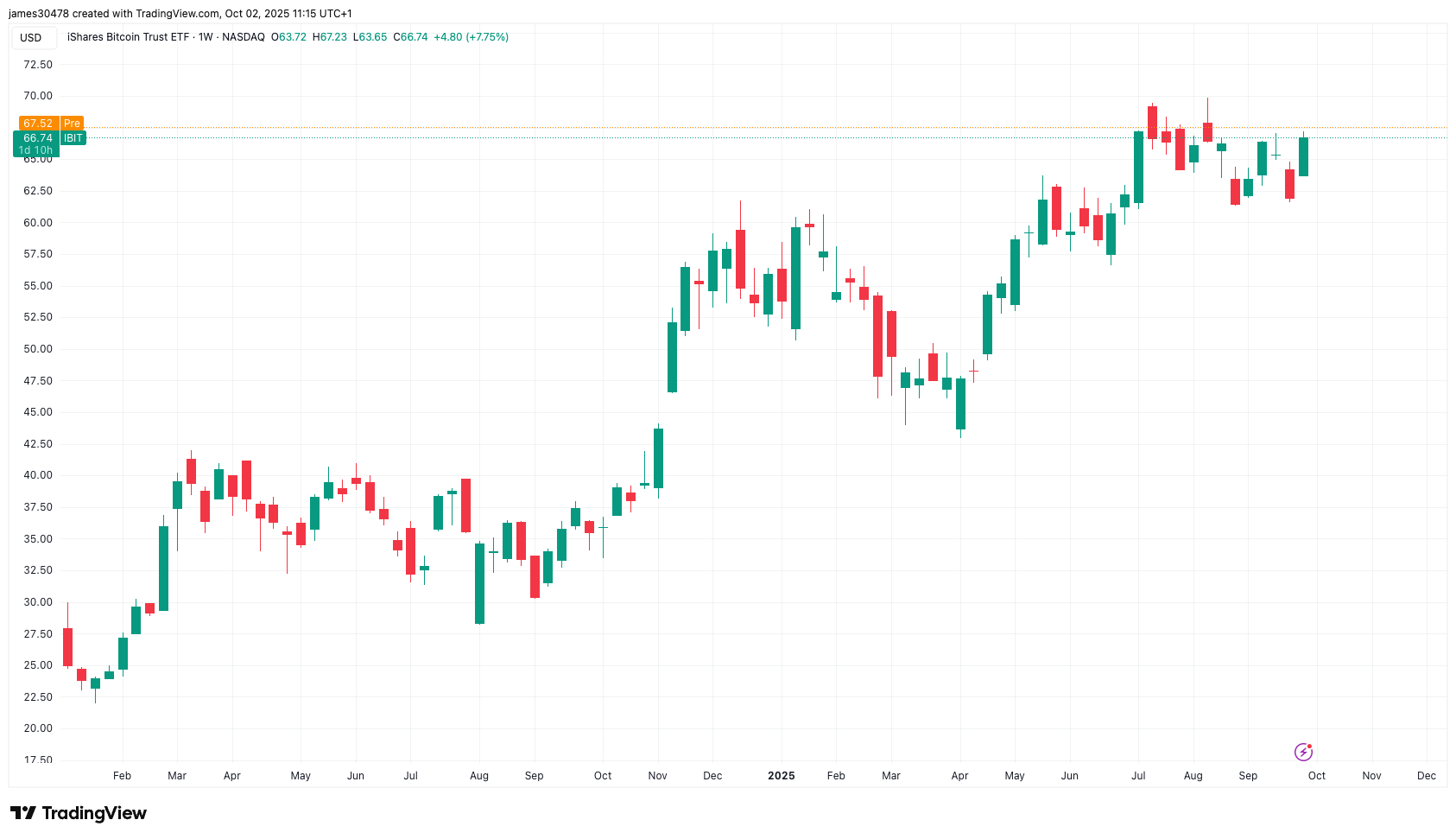
Institutional interest in bitcoin and digital assets continues to hit new milestones, even as macro turbulence roils traditional markets. BlackRock’s iShares Bitcoin Trust (IBIT) recently entered the world’s top 20 ETFs by assets, amassing $90.7 billion AUM according to Bloomberg analysis. Bitcoin’s 4% surge on the day landed just shy of its top ten daily moves in 2025. IBIT saw $405.5 million in inflows, its highest single-day net intake since mid-August.
Such inflows into exchange-traded funds underscore growing investor confidence in the regulatory maturing of the crypto sector—following landmark approvals of spot bitcoin and Ethereum ETFs in the U.S., Europe, and Asia earlier in 2025. The proliferation of ETF products, including Thailand exploring new offerings and European banks like BBVA teaming up for retail crypto trading, signals rapid institutionalization of digital assets worldwide.
Trading Volumes Touch Yearly Highs

Data compiled by CoinDesk reveal that combined spot and derivatives trading on centralized exchanges soared to $9.72 trillion in August 2025—up 7.58% from July and the year’s highest figure. Open interest across centralized derivatives platforms climbed nearly 5% to $187 billion, showcasing heightened speculative activity and a resurgence in risk appetite. Volume growth on platforms like Gate, which saw a 98.9% increase to $746 billion, signals an increasingly diverse and competitive exchange landscape.
What Lies Ahead for Crypto
As the U.S. moves deeper into a potentially protracted government shutdown, the knock-on effects for monetary policy and fiat liquidity could be profound. Delayed data releases complicate the Federal Reserve’s calculus, potentially accelerating dovish pivots that favor non-sovereign digital assets. Major cryptocurrencies, led by Bitcoin, have historically thrived in such uncertain environments, as demonstrated by the multi-month highs currently being printed.
Downside risks remain—should markets panic or if the shutdown causes broader risk-off sentiment, even bitcoin could face headwinds. However, as regulatory frameworks continue to mature globally and institutional adoption accelerates, blockchain-based assets appear well-positioned for continued momentum, particularly as the traditional playbook for asset allocation is thrown into question.
Industry voices agree that this juncture is critical for investors: “Bitcoin’s resilience amid macro shocks and dislocated data highlights its role as a new-age refuge asset in the digital economy,” Mena concluded.
Conclusion
With the U.S. government shutdown providing the spark, the wider crypto market is seeing its most dynamic period yet in 2025. Bitcoin’s rally, surging trading volumes, option activity, and heavyweight ETF inflows all point to a sector that is not just surviving volatility—but thriving on it. As policymakers, traders, and institutional investors adjust to an evolving financial landscape, digital assets are cementing their place at the center of global finance.


