
China Hosts First Fully Autonomous AI Robot Football Match: A New Era for Sports and Robotics
By Global Tech News Desk | June 30, 2025
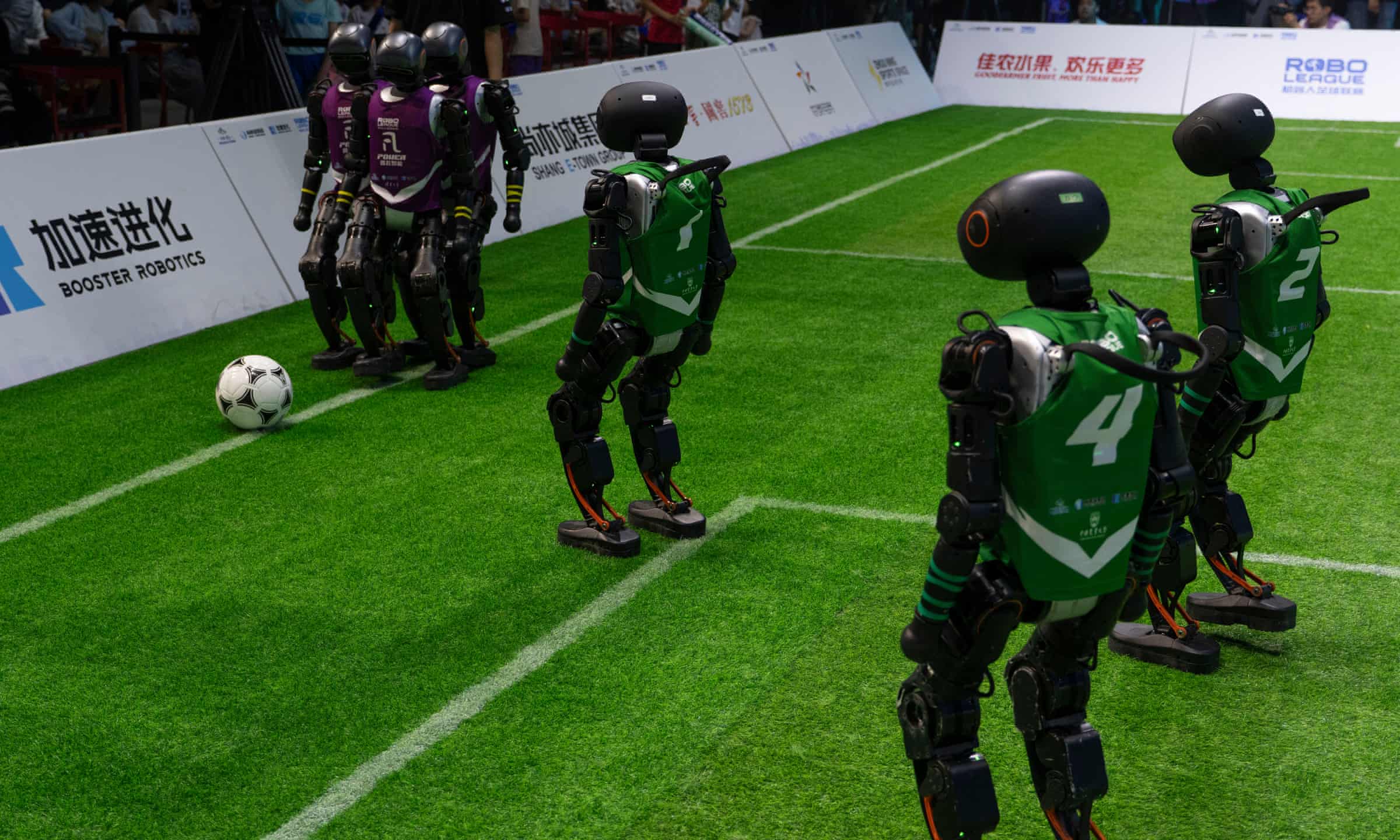
In a landmark event for both artificial intelligence and sports, Beijing played host this weekend to the world’s first fully autonomous AI robot football match. Organized under the banner of RoBoLeague, the inaugural event featured teams of sophisticated, AI-driven robots that operated entirely without human instruction, marking a historic leap in the deployment of AI in real-time strategic environments.
The tournament brought together leading robotics firms including Booster Robotics, whose T1 humanoid robots became the stars of the field. These advanced machines were programmed to independently navigate, strategize, and compete, all guided by cutting-edge machine learning algorithms developed specifically for dynamic teamwork and competitive play.
A Showcase for the AI Revolution in Sports
This demonstration marks a pivotal moment for both the technology and sports communities. The RoBoLeague match in Beijing not only displayed the capabilities of modern AI and robotics, but also acted as a public testbed for next-generation machine learning in real-world scenarios. Visitors watched as the robots made split-second tactical choices, coordinated as teams, and adapted strategies mid-game—capabilities made possible only in the past few years by exponential advances in AI autonomy and sensor fusion.
Dr. Lin Qiang, lead systems architect at the Institute for Robot Intelligence in Beijing, commented: “What we are seeing here is more than just entertainment. The level of complexity, coordination, and decision-making exhibited by these machines rivals the kind of reasoning and responsiveness previously only found in human athletes.”
This is a natural progression for China, which has invested heavily in robotics and AI, aiming to become the global leader in intelligent manufacturing and automation. According to the China Artificial Intelligence Development Report 2025, the nation’s AI sector has now surpassed $35 billion in total market value, with robotics playing a key role.
How the Technology Works
The T1 robots on display used a combination of computer vision, advanced sensor arrays, and reinforcement learning models to parse the environment and react instantly to the ever-changing dynamics of the match. Their neural networks evaluated thousands of possible actions per second, balancing offensive and defensive strategies according to real-time game state analysis.
“Each robot is equipped with multiple AI agents,” explained Su Ming, Chief Engineer at Booster Robotics. “There are separate models for object detection, situational awareness, teammate coordination, and game strategy, all working in parallel. What’s remarkable is that the only input during the match was the initial kickoff command—everything else, from passing to scoring, was left to the machines.”
- Computer vision allows the robots to identify the ball, teammates, and opponents.
- Reinforcement learning enables tactical evolution over matches and practice sessions.
- Multi-agent systems support teamwork, with the robots communicating seamlessly.
- High-efficiency motors and advanced batteries let these humanoids sustain play for nearly an hour per match.
All software and hardware were developed to comply with international safety standards, and live matches were monitored by on-site engineers for emergencies—though none were reported during this historic debut.
Implications for the Global Robotics Industry
The success of China’s autonomous robot football match signals more than just a sports novelty: it’s a testament to the accelerating capabilities of AI-powered robotics. Industry experts forecast a boom in related applications, with direct implications for warehouse automation, defense training, emergency response, and even advanced healthcare robotics.
The global market for service robots, already valued at over $40 billion in 2024 according to the International Federation of Robotics, is projected to grow by more than 17% annually through 2030, driven largely by autonomy breakthroughs demonstrated in competitions like RoBoLeague.
International tech giants including Boston Dynamics, SoftBank Robotics, and Hyundai Robotics are also investing in similar technologies, but Beijing’s debut places China squarely at the forefront of public-facing AI sports innovations.
Public Reception and Next Steps
The match drew thousands of attendees in person and was livestreamed globally, attracting millions of viewers and sparking viral conversations across tech and sports social media. Analysts note that this rising interest is likely to spur competitions worldwide, with collegiate and professional autonomous robot leagues already in the planning phases in the U.S., Europe, and Southeast Asia.
“We expect the next five years to see rapid progress,” stated Professor Elena Zhou, robotics researcher at Tsinghua University. “The future of sports will blend human and AI-driven competitions, challenging both athletes and machines to push the limits of cooperation and skill.”
The Chinese government has already announced funding for expanding RoBoLeague to additional cities and developing more sophisticated AI training platforms aimed at both sports and industrial applications.
Conclusion
The first fully autonomous AI robot football match hosted in Beijing is more than a technological spectacle—it’s a window into how artificial intelligence is reshaping human experiences, industries, and even the meaning of competition. As machines become ever more capable collaborators and competitors, the implications for sports, business, and society at large are profound and still unfolding.
Expect to see more headlines—and more breathtaking plays—from the world’s newest AI athletes in the very near future.


