
Elon Musk Becomes the World’s First Half-Trillionaire Amid Tesla, SpaceX, AI Growth
Published: 9 hours ago · By: Peter Hoskins, Business Reporter
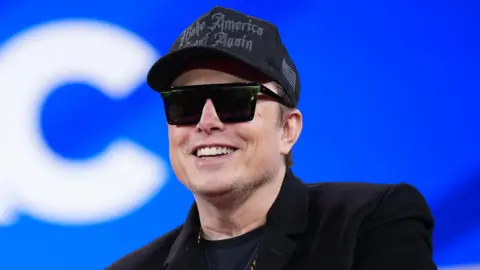
Elon Musk has made history by becoming the world’s first half-trillionaire, as reported by Forbes’ billionaires index. On Wednesday afternoon in New York, Musk’s net worth briefly surpassed $500.1 billion before closing just above $499 billion, highlighting a year marked by surging valuations at his leading companies—Tesla, SpaceX, and artificial intelligence venture xAI. This staggering personal fortune places Musk far ahead of his closest rival, Oracle founder Larry Ellison, whose net worth is estimated at $350.7 billion.
Unprecedented Wealth Amid Company Growth
Musk’s ascension to half-trillionaire status is closely tied to the spectacular performance of his business empire. Tesla, the world’s most valuable electric vehicle (EV) company, continues to see sharp increases in its share price. In the first half of this year alone, Tesla shares soared by over 20%, finishing Wednesday’s trading session up 3.3%. Analysts attribute the surge to renewed investor confidence as Musk dedicates more attention to the company and strategic innovations in EV technology, artificial intelligence, and robotics.
Meanwhile, SpaceX, his aerospace firm, is revolutionizing satellite internet services through its rapidly expanding Starlink network and marking historic milestones in reusable rocketry. The company has been valued on secondary markets at more than $180 billion, making it one of the world’s most valuable private companies. This year, SpaceX has secured contracts with both the US government for national security launches and global telecommunications providers, fueling expectations for further valuation hikes.
Pushing the Boundaries in AI and Robotics
A significant contributor to Musk’s net worth surge is xAI, his artificial intelligence startup launched in 2023. Valued recently at $24 billion after a major financing round, xAI specializes in developing “truthful” AI models—including Grok, a conversational AI rivaling OpenAI’s ChatGPT and Google’s Gemini. The company has attracted top talent and venture capital, and its integration with Musk’s social platform X (formerly Twitter) is expected to open new revenue streams and diversify X’s offerings.
Tesla itself is undergoing a strategic transition, expanding core automotive business into AI and robotics. The company has set ambitious internal goals—if met, Musk could earn a pay package exceeding $1 trillion over the coming decade. These targets include increasing Tesla’s valuation eightfold, selling 1 million humanoid Optimus robots, and achieving unprecedented EV sales milestones. Such bold objectives have stirred excitement among investors and further underpinned Tesla’s skyrocketing valuation.
Market Confidence and Strategic Moves
Investor faith in Musk’s leadership was underscored last month when he disclosed a personal purchase of $1 billion in Tesla shares. This direct investment, combined with recent share buybacks and a boardroom focus on core operations, sent a strong signal of conviction in the company’s future prospects. Tesla board chair Robyn Denholm remarked in September that Musk has become “front and centre” in guiding the automaker through its next phase of innovation and growth.
Musk’s high-profile involvement in both technical and strategic roles across his ventures has, however, not been without controversy. Earlier this year, he faced criticism for his role with the Trump administration’s Department of Government Efficiency (DOGE) and outspoken positions on immigration and diversity, equity, and inclusion (DEI) initiatives. Despite these challenges, markets have increasingly rewarded Musk’s refocusing on technology and business execution over political engagement.
Competitive Landscape and Future Challenges
Tesla faces fierce global competition, particularly from Chinese automaker BYD, now the world’s top EV seller, and a wave of innovative rivals in Europe and the US. The company is also navigating margin pressures driven by price competition and an urgent need to localize supply chains amidst ongoing US-China trade tensions. However, Tesla’s forward-looking investments in battery technology, full self-driving software, and AI-powered manufacturing give it a distinct competitive edge, with new product launches and expansion into robotics expected to buffer the brand’s resilience.
SpaceX, meanwhile, continues to outpace established aerospace contractors in launch cadence and cost. Plans for Starship—a fully reusable super-heavy rocket—promise to further slash costs and unlock commercial and scientific missions on the Moon and Mars. Starlink, now serving over 3 million users globally, is pioneering internet access in conflict zones and remote areas, with recent initiatives in Ukraine and Africa drawing international attention.
The Expanding Scope of Musk’s Empire
Beyond Tesla and SpaceX, Musk remains active in ventures like Neuralink, which recently received FDA clearance to commence human trials for brain-computer interfaces, and The Boring Company, aiming to revolutionize urban transportation with underground hyperloops.
Musk’s sprawling business interests and personal fortune represent a new era of technology entrepreneurship—one where innovations in AI, mobility, and space bring not only financial rewards but also propel transformative changes across industries and society at large.
The Road Ahead
As the world’s first half-trillionaire, Musk’s next decade is likely to be defined by both monumental achievements and unprecedented expectations. Meeting his own ambitious milestones—such as mass-producing AI robots or establishing lunar infrastructure—will test the limits of both technology and market patience. But if Musk’s recent track record is any indication, the business world—and the public at large—will be watching closely to see what comes next from the world’s most valuable entrepreneur.


