
Elon Musk Responds to Nvidia CEO Jensen Huang’s Enthusiasm for xAI Amid Generative AI Boom
Published: October 9, 2025 | Source: Times of India
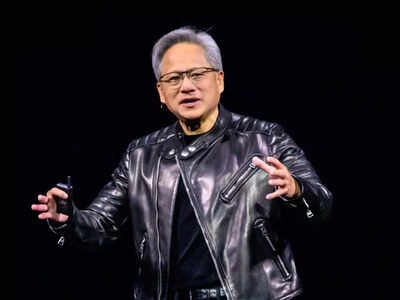
In a recent interview with CNBC, Nvidia CEO Jensen Huang expressed his deep enthusiasm for Elon Musk’s artificial intelligence venture xAI, highlighting the growing excitement around next-generation AI startups shaping the computing landscape. Huang admitted, “The only regret I have is I didn’t give him more money,” referencing Nvidia’s investment in xAI and signaling the chipmaker’s recognition of Musk’s history in building transformative technology companies.
Elon Musk, who leads both Tesla and xAI, responded with characteristic brevity via his social platform X, stating, “Nice of Jensen to say so.” This public exchange comes as investor and industry attention on generative AI—particularly large language models and advanced GPU-powered infrastructure—continues to upend global tech priorities.
Nvidia’s Strategic Bet on xAI
Huang’s comments are more than a courtesy; they underscore Nvidia’s strategic philosophy in the rapidly developing AI ecosystem. Nvidia, already the global leader in GPU technology, has seen explosive demand as foundational models like those from OpenAI, Anthropic, and xAI require vast computational horsepower to train and operate. Nvidia has actively invested in numerous AI startups, with its chips now virtually synonymous with modern AI research and development.
“Almost everything that Elon is part of, you really want to be part of as well,” Huang said, noting that Nvidia’s involvement in xAI was a deliberate bet on what he views as a cornerstone of the future AI landscape. He drew a distinction between traditional vendor-financing—deals made simply to secure hardware sales—and true strategic partnerships built around mutual belief in world-changing innovation.
As of late 2024, xAI had reportedly raised at least $6 billion at a valuation of $24 billion, making it one of the most watched generative AI startups globally. Nvidia’s willingness to invest reflects both confidence in Musk’s vision and the growing consensus that few entrepreneurs have Musk’s track record in scaling revolutionary technologies—think SpaceX, Tesla, and formerly OpenAI, where Musk was an early founder before departing in 2018.
The Competitive Generative AI Landscape
The race to dominate the next wave of generative AI is heating up. xAI, OpenAI, Anthropic, and Google’s Gemini platform are all developing large language models (LLMs) that power applications from search and coding to multimodal content creation. With billions pouring in from venture capital, Big Tech, and sovereign funds, the pace of innovation and infrastructure buildout has become ferocious.
Huang observed that the industry’s shift from traditional CPU-based systems toward GPU-centric AI has only just begun. He predicted a “multi-trillion-dollar infrastructure buildout” as businesses across industries—from healthcare and financial services to automotive and education—implement generative AI at scale. Nvidia, as the leading supplier of AI chips like the H100 and new Blackwell B200, has posted record revenues in 2024 and early 2025, with quarterly sales often doubling year-over-year.
Among the rising stars Nvidia has supported, Huang also mentioned his wish to have invested more in CoreWeave, a cloud provider specializing in GPU infrastructure. This reflects Nvidia’s agile, risk-friendly approach to seeding the AI ecosystem, ensuring it remains at the heart of global AI expansion.
xAI’s Ambition and Recent Developments
xAI, founded by Musk in 2023, has quickly risen to prominence. Its flagship model, Grok, offers conversational abilities and real-time web access, setting it in direct competition with OpenAI’s GPT-4 and Google’s Gemini models. Unlike some rivals, Musk has positioned xAI as “maximally curious and less censored,” appealing to both business applications and Musk’s fanbase.
In 2024, xAI rolled out Grok for X Premium subscribers, further integrating AI into Musk’s reimagined social platform. The company has stated ambitions to build models that are not only highly capable but also transparent in their training data and decision-making, a nod to Musk’s long-standing calls for AI “truth-seeking.”
As of mid-2025, reports suggest xAI has secured additional partnerships and is hiring aggressively for AI researchers and engineers. The company is also rumored to be working on next-generation multi-modal models that can handle text, images, audio, and even video. Its fundraising success—bringing in heavyweight investors like Andreessen Horowitz and Sequoia Capital—signals broad belief in Musk’s disruptive potential despite increasingly stiff competition.
The Nvidia-Musk Relationship: A Pillar of the AI Revolution
While Nvidia’s contributions underpin nearly every major AI breakthrough—from OpenAI’s ChatGPT to Google DeepMind’s AlphaFold—its concerted effort to back startups like xAI reflects a clear calculation: the next era of computing will be defined by those who can scale large AI models securely and ethically. The close rapport between Huang and Musk also signals a powerful alignment between hardware, infrastructure, and AI model development at the highest levels.
This mutual recognition, even when expressed with characteristic brevity by Musk (“Nice of Jensen to say so”), is significant. As generative AI reshapes industries and daily life, leadership from figures like Huang and Musk will set the tone for how AI is developed, deployed, and governed globally.
Looking Forward: Challenges and Opportunities
The AI sector faces massive opportunities and notable risks. From the energy consumption required by giant compute clusters to ethical debates over model bias, transparency, and the impact of deepfakes, the choices made by leaders such as Musk and Huang today will echo for decades. Global regulators are catching up, with the EU’s AI Act and US executive orders aiming to set early guardrails for deployment and safety.
Meanwhile, the market shows no signs of cooling. The AI chip market alone is projected to exceed $400 billion by 2027, while AI SaaS platforms are being integrated into daily enterprise operations at an unprecedented rate. Morgan Stanley recently estimated that generative AI could add $4.4 trillion in annual global economic impact by 2030.
For xAI, Nvidia, and their respective peers, the window is wide open for those willing to invest boldly and build resilient, responsible AI ecosystems. As Huang’s comments and Musk’s response illustrate, being part of the AI future means cultivating both visionary leadership and equally ambitious partnerships.


