
How CEO Jensen Huang’s Son and Daughter Make Nvidia Silicon Valley’s First ‘Family Business’
By TOI Tech Desk | August 18, 2025
Nvidia, the world-leading AI and chip company, has always operated at the cutting edge of technology and industry trends. Now, more than ever, it is redefining corporate succession and leadership models in Silicon Valley. With founder and CEO Jensen Huang’s children—Madison and Spencer—holding top executive positions in the firm, Nvidia is emerging as the preeminent example of a family business at scale among Big Tech, stirring both admiration and debate about the implications for innovation, governance, and meritocracy in tech.
The Rise of the Huang Siblings
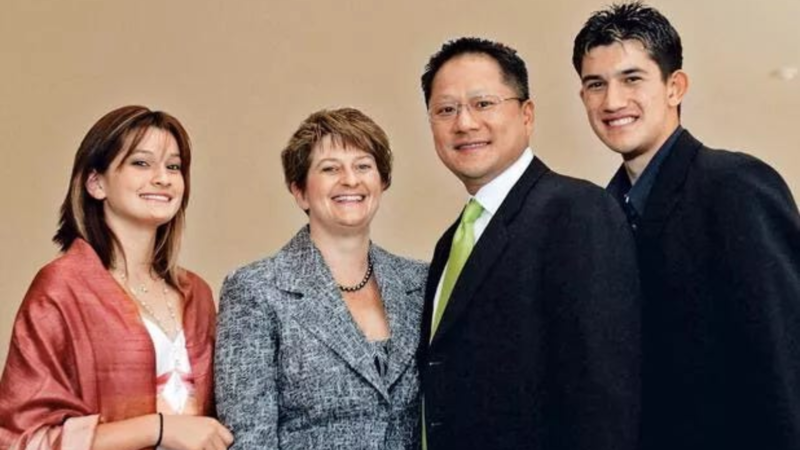
Madison Huang currently leads Nvidia’s Omniverse division, responsible for advanced 3D simulation and collaborative platforms. Her brother, Spencer Huang, oversees development in AI models and robotics perception systems. The siblings took unconventional paths to their current roles. Madison, initially pursuing culinary arts in Paris and then working at LVMH, and Spencer, previously running a popular Taipei bar and R&D lab, returned to the tech fold after a joint MIT AI course rekindled their interest. Both started as interns at Nvidia in 2020 and 2022 respectively.
Their rapid rise, especially Madison’s swift ascent to director and seven-figure compensation by 2023, has attracted notice even in the fast-moving world of Silicon Valley. Colleagues describe Madison as “intensely driven” and “demanding,” while Spencer brings a more collaborative style reminiscent of his father’s pragmatic approach. The siblings are not embedded in Nvidia’s core GPU business—which powers everything from generative AI to cloud infrastructure—but rather in new strategic areas seen as the company’s growth pillars for the next decade.
Breaking Silicon Valley Tradition
It is rare for the children of Silicon Valley founders to play major executive roles in their parents’ companies. Names such as Gates, Jobs, and Zuckerberg have kept direct family members publicly and professionally distanced from business operations. Nvidia’s turn towards a multi-generational leadership model sets a unique precedent at a time when the market capitalization of Big Tech firms rivals that of many national economies. As of August 2025, Nvidia’s market value surpasses $3 trillion, making it not just the dominant AI chip supplier, but also a pivotal powerbroker in the AI era.
This contrast with tradition is reflective of Asia-based family conglomerates but nearly unprecedented in U.S technology. It spotlights evolving perspectives on succession planning amidst growing calls for stability and cultural continuity in globally influential corporations. Corporate governance experts note that while this approach offers unique advantages in preserving founder vision and long-term ambition, it also introduces new scrutiny on oversight, talent management, and the risks of nepotism.
Nepotism or Strategic Talent Pipeline?
Not surprisingly, the advancement of Madison and Spencer has sparked discussions regarding nepotism versus meritocratic advancement. This concern has only been amplified by reports that children of other senior Nvidia executives, including co-founder Chris Malachowsky and Director Aarti Shah, are also on the company’s payroll.
Jensen Huang directly addressed these issues in a recent town hall, noting, “No responsible parent would recommend their child if it could risk embarrassment or failure for them or the company.” He emphasized the siblings’ unique contributions to Nvidia’s expansion, particularly in divisions that require new thinking and bridging generational change in AI and simulation technology. Their presence is seen as an effort to blend entrepreneurial spirit with continuity, positioning Nvidia for enduring relevance even as the AI landscape faces fierce new competition and unprecedented regulatory attention around the world.
Nvidia’s Family Model: The Industry View
Nvidia’s workforce, which surpassed 40,000 employees globally in 2025, reflects multi-generational diversity, with an increasing number of high-performing second-generation professionals rising within the ranks. According to Forbes analysis, companies with strong founder-family involvement — if managed with professional rigor — can outperform purely outsider-managed firms in innovation cycles and resilience.
Madison Huang’s emergence as a visible face of Nvidia’s vision was evident at Computex Taipei 2025, where she drew “rock star” reception from industry insiders and media. Spencer’s application of data-driven management, modeled after his father’s “five-key priorities” mandate, is credited with boosting the performance of Nvidia’s next-generation robotics and AI teams.
Such developments hint at Nvidia’s ambition not only to dominate chips, but also to shape how enterprises and consumers interact with AI, the metaverse, and digital-twin technology. The Huangs, by embedding their family into strategic innovation, offer a living case study on the evolution of leadership in an era where technology, capital, and family business overlap on a global scale.
What Does This Mean for Nvidia and Silicon Valley?
Nvidia’s approach could influence a broader rethink about succession and governance across the tech sector. At a time when many Silicon Valley giants struggle with questions about stewardship, continuity, and the lure of “professional CEOs,” the Huangs model a pathway where founder legacy—and family trust—remain integral to corporate DNA without stifling innovation or mobility.
That said, this experiment is closely watched. Investors and stakeholders will expect transparency and continued performance, especially as Nvidia faces scrutiny on anti-trust, U.S.-China export restrictions, and the race to maintain AI hardware leadership against rivals like AMD, Intel, and newcomers such as Google and Amazon’s in-house chip teams.
For now, the “first family of Silicon Valley” sets the tone for an AI era where generational succession and dynamic innovation can, in the best cases, reinforce each other. The ultimate legacy will be measured not by name alone, but by how Nvidia adapts—and leads—amidst the fastest-moving technology landscape in history.


