
Is the AI Boom Finally Starting to Slow Down?
A Cooling Period in the AI Hype Cycle
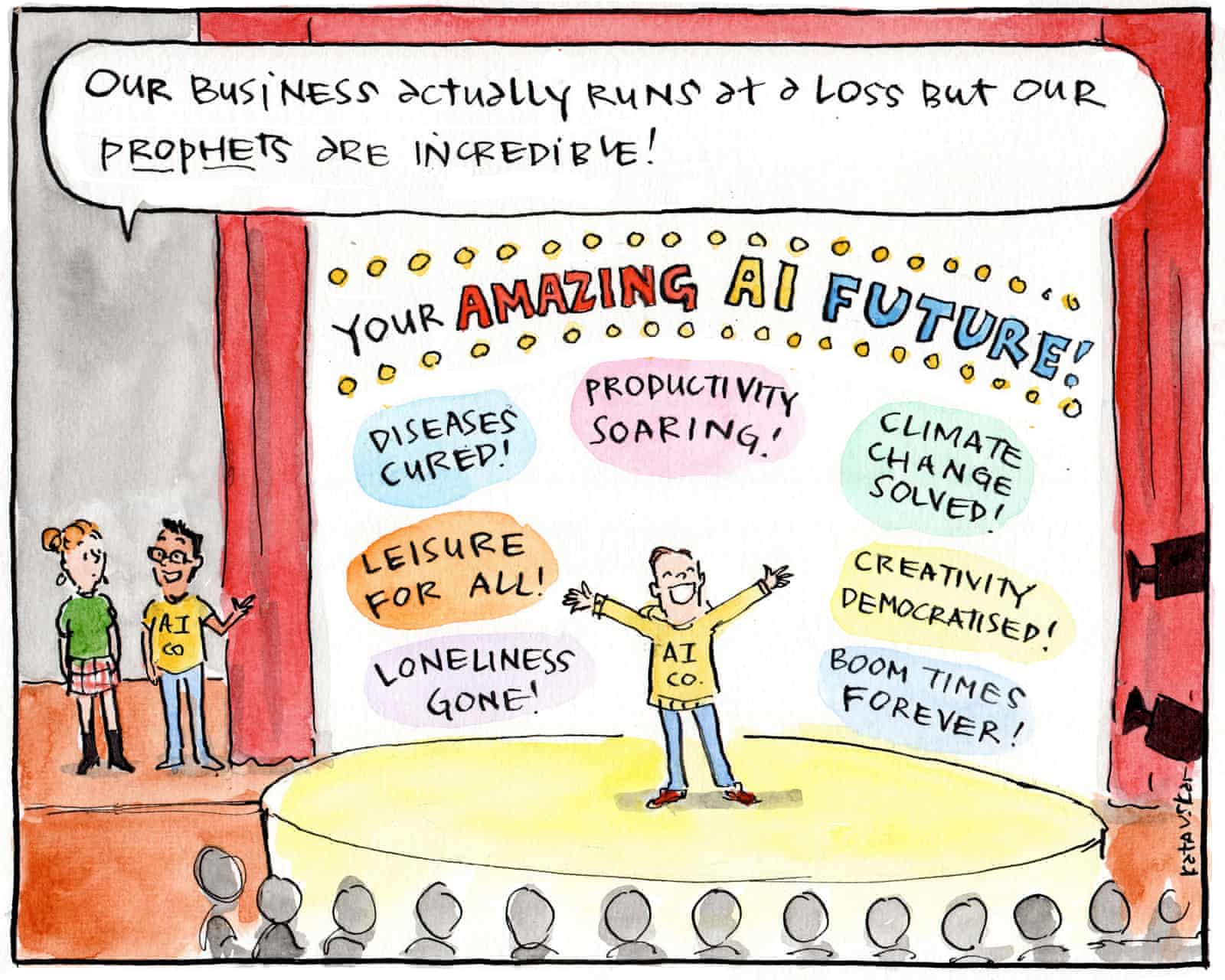
For the last several years, artificial intelligence has dominated both Silicon Valley’s imaginations and Wall Street’s balance sheets. From self-driving car investments to the generative AI arms race, every aspiring tech company has repositioned itself as an AI company. But despite seemingly endless promotion and bullish forecasts, a new market reality may be settling in. Recent stock market turbulence and internal company turmoil suggest some air might finally be leaking out of the AI bubble.
Despite the proliferation of AI startups and massive investments from tech giants, some industry leaders have begun publicly voicing caution. OpenAI CEO Sam Altman, a prominent evangelist of generative AI, recently acknowledged that “investors as a whole are overexcited about AI.” He even conceded that OpenAI mismanaged the rollout of its latest model, GPT-5, a launch widely anticipated to set a new benchmark over the already advanced GPT-4.5. These doubts from one of the field’s pioneers have not gone unnoticed by the investment community.
Tech Stocks Take a Hit
The financial markets have responded quickly to this change in sentiment. Several companies at the heart of the AI boom—think Palantir, Oracle, Nvidia, AMD, and ARM—have seen swift declines. Last week, Palantir’s shares dropped by 9%, Oracle by 5.8%, Nvidia slipped 3.5%, and AMD along with ARM saw drops of at least 5%. This correction contrasts starkly with the market rally seen in other sectors that benefited from expectations of lower interest rates, suggesting that investors now differentiate more sharply between hype and actual performance in tech.
Industry analysts point to a new MIT study reporting that 95% of enterprise generative AI pilots have resulted in little to no real revenue growth. The promise that AI would rapidly transform bottom lines appears overblown—at least for now. Many companies are facing a gap between innovative demonstration projects and actual, scalable commercial application. This has intensified scrutiny over massive capital expenditures on AI infrastructure and raised pressing questions about when, or if, substantial ROI will materialize.
The Human Impact: AI Hiring Freezes and Layoffs
This period of correction is having real-world consequences for the tech workforce. Most notably, Meta—one of AI’s biggest spenders—recently announced a freeze on AI hiring, even as executives hurried to assure investors that ambition in the space has not diminished. Meta’s chief AI officer, Alexandr Wang, reiterated that the company would continue investing heavily in its “Meta Superintelligence Labs” division, but did not deny that headcount for specific AI roles was being limited.
Meta is not alone. TikTok’s parent company ByteDance is undergoing a significant global restructuring by cutting hundreds of jobs in its trust and safety teams across the UK, Asia, and Europe. The company is accelerating its shift toward using AI for content moderation, reporting that automated systems already handle about 85% of content removals on its platform. The drive toward automation has prompted strikes, as seen among TikTok’s German workers, and has raised concerns about upholding quality and responsibility in digital spaces. American companies like X (formerly Twitter) and Meta have similarly scaled down their human moderation teams, raising complex questions about online safety, accountability, and the limits of AI judgment.
Investor Nerves and the Burden of Hypergrowth
Investor confidence is further being tested by the staggering sums now involved in AI infrastructure. At a recent dinner with journalists, Altman suggested that OpenAI would need to spend in the “trillions” to build out the necessary datacenter capacity in the near future. While last quarter’s earnings for tech companies were largely positive, these eye-watering capital expenditure projections are causing investors to demand immediate evidence of transformative value.
Eric Schmidt, former CEO of Google, echoed these warnings, emphasizing that Silicon Valley’s obsession with achieving artificial general intelligence (AGI) may be misguided and potentially even counterproductive. In a recent column, Schmidt argued that the relentless focus on AGI is alienating the public and distracting industry from more pragmatic opportunities to deploy AI for immediate societal benefit. He highlighted a growing disconnect between the world of AI technologists, brimming with optimism, and a general public now skeptical of overblown claims and concerned about the technology’s real-world impacts.
Cultural Shifts: Emotional Bonds and Resistance

For heavy users, AI’s integration into daily life is affecting more than just commerce and jobs—it’s also producing new emotional bonds. OpenAI’s ChatGPT, for instance, has developed legions of devoted users who report forming strong attachments to its personalities and conversational style. The rollout of new, more advanced models has, for some, felt like a personal loss: abrupt changes to familiar AI systems evoke discomfort, anxiety, and a genuine sense of grief. OpenAI has responded by offering users continued access to previous chatbot versions via its paid subscriptions, signaling that customer trust is as valuable as technological advancement in the age of AI companions.
The Broader Picture: Content Moderation and Regulation
The automation wave is especially pronounced in the space of online content moderation. With more than 85% of content removals on TikTok handled by AI, and similar steps being taken by competitors like Meta and X, the tech industry is effectively putting machines in charge of policing digital civility at scale. While leading to cost savings and speed, it also brings risks of bias, over-censorship, and reduced transparency—challenges highlighted by recent industry studies and high-profile moderation controversies. Regulatory pressure is mounting, as governments around the world debate new laws and oversight for content moderation and AI governance.
Meanwhile, the future of TikTok itself remains uncertain in the United States, with ongoing regulatory scrutiny and the prospect of a ban never far from political headlines. In Europe, the platform has nonetheless reported a 38% increase in revenue, underlining the underlying business strength that AI continues to fuel, despite public debate and structural upheaval.
Looking Ahead: The Next Reality Check
The next significant market test will be the upcoming earnings report from Nvidia, whose GPUs remain foundational across almost every leading AI system. Analysts, while optimistic, are keenly aware that any signs of cooling infrastructure investment or a failure to meet outsized financial expectations could be a catalyst for a broader shakeout in the AI sector. Whether this is merely a brief correction or the start of a more prolonged adjustment remains to be seen.
As AI merges ever deeper into technology, business, and culture, the line between bold vision and grounded execution is becoming the central tension of the 2020s. Investors, companies, and the public alike must now weigh the grand promises of superintelligence against the real, sometimes messy, process of delivering social and economic value. While the AI hype cycle may be cooling, the race to define AI’s future practical role—and its regulatory framework—has only just begun.


