
Meta Commits Hundreds of Billions to Establish AI Superintelligence Leadership
Published July 14, 2025
Meta Platforms, Inc. (NASDAQ: META), formerly known as Facebook, has made a resounding statement in the global artificial intelligence (AI) race by announcing an unprecedented investment of hundreds of billions of dollars in its AI infrastructure. Under the stewardship of CEO Mark Zuckerberg, Meta is launching a sweeping expansion of its data center footprint and compute capabilities, aiming squarely at the creation of artificial general intelligence (AGI).
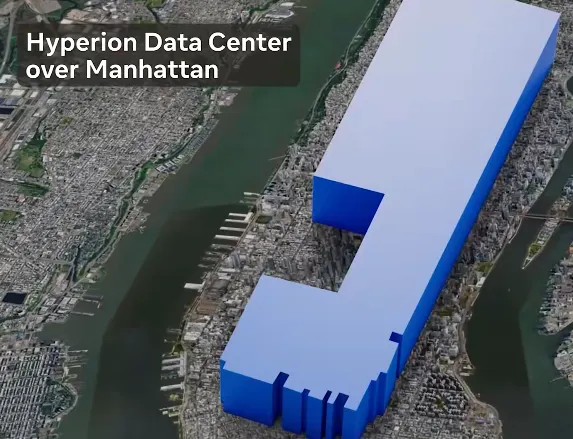
This ambitious program will see Meta construct multiple multi-gigawatt data center complexes across the United States, starting with the Prometheus project in Ohio and swiftly followed by the Hyperion cluster in Louisiana. These facilities are designed to house enormous computational resources, powered primarily by the latest generation of NVIDIA’s H100 AI superchips. Meta expects to accumulate a staggering 600,000+ H100 chips—triple the estimated holdings of rivals such as OpenAI and xAI—ushering in what Zuckerberg calls “industry-leading levels of compute and by far the greatest compute per researcher.”
Data Center Mega-Clusters: Prometheus and Hyperion
The Prometheus data center, the first of these mega-clusters, is on track for activation in early 2026, representing a scale and investment rarely seen outside sovereign-level economic programs. According to industry sources and Meta’s own disclosures, the Prometheus cluster alone could require capital outlay rivaling the annual GDP of some smaller nations.
Each cluster will comprise thousands of racks filled with NVIDIA H100 Tensor Core GPUs, sophisticated cooling and energy solutions, and high-speed fiber interconnections totaling millions of networked threads. NVIDIA H100 chips are the current standard for large-scale AI workloads, supporting multi-trillion parameter models for both training and inference. By comparison, OpenAI and xAI are widely believed to possess approximately 200,000 H100 units each, leaving Meta with a historic lead in total compute capability for deep learning and generative AI research.
Meta’s Superintelligence Push: Ambition and Competition
Meta’s stated objective for these mega-clusters is clear: to achieve breakthroughs in artificial general intelligence. While current AI models, including Meta’s own Llama 3 and OpenAI’s GPT-5 precursors, have excelled in pattern recognition and natural language processing, they fall short of the full spectrum of AGI capabilities. True AGI would entail machines capable of flexible reasoning, self-directed learning, and creativity indistinguishable from—or surpassing—human cognition.
“This is just the beginning,” Zuckerberg said at a recent announcement, adding that Meta’s data centers “will enable a new era of superintelligent systems that can power advances in science, medicine, climate modeling, and creativity.”
Unlike strictly academic AGI projects, Meta’s approach leverages its enormous troves of social, visual, and textual data harvested from Facebook, Instagram, WhatsApp, and Reality Labs. The company has also been aggressively recruiting AI talent, poaching leading experts from Silicon Valley and top research institutions globally. Industry observers note Meta’s ability to combine vast datasets, deep technical talent, and essentially unlimited capital—creating a unique, if controversial, position in the technology ecosystem.
Raising the Bar in AI Compute Power
Such extreme concentration of compute raises both excitement and concern across the industry. The “compute gap” between Meta and competitors such as Google DeepMind, Microsoft+OpenAI, Amazon, and emerging rivals like xAI is growing at an exponential rate. According to SEMI and IDC, global demand for AI graphics chips and server infrastructure is predicted to surpass $250 billion in investment by late 2026, with Meta accounting for a significant portion of that total.
The two U.S. states selected for these mega-clusters—Ohio and Louisiana—were chosen for their favorable access to green energy, robust fiber backbone, and state-level incentives. Meta has pledged to invest heavily in renewable power sources to sustain the gigantic energy consumption anticipated, a move in line with industry trends towards carbon-neutral AI development.
Industry critics and privacy advocates have raised questions about the social and ethical guardrails on AI research at this scale, especially in light of the potential for AGI to disrupt labor, governance, and even global security norms.
The AGI Race: Implications and Outlook
Meta’s monumental investment marks a paradigm shift not only in corporate R&D but also in the competitive landscape of AI globally. While generative AI tools such as chatbots and image/video synthesizers are rapidly being incorporated into products and workflows, true AGI remains the elusive “holy grail”. Success would unlock exponential growth in productivity, science, and healthcare—but also comes with significant risks, ranging from economic dislocation to existential concerns.
For now, Meta’s lead in compute and talent elevates it above even its nearest competitors, and the Prometheus and Hyperion data centers are widely expected to fuel successive breakthroughs in language, vision, and multi-modal AI models throughout the next decade. This has already spurred a flurry of new funding and partnerships among rivals; Microsoft, Google, and Amazon have each announced major new investments in cloud and AI infrastructure in 2025, but none yet match the scale of Meta’s commitment.
What Comes Next?
The first phase of Meta’s Prometheus facility is scheduled to go online in early 2026, with Hyperion closely following, signaling a dramatic elevation of the global compute baseline for AI research. As the boundaries between big tech and sovereign-level science blur, pressure will mount for regulatory frameworks, international cooperation, and deep public engagement in shaping the future of artificial intelligence.
Investors and policy-makers alike are watching Meta’s experiment closely. Whether this colossal bet will result in true superintelligence, or provoke new debates on the limits of machine cognition and corporate power, remains to be seen. But for now, Meta sits firmly at the vanguard of the AI revolution—challenging competitors and promising to redefine how we think about intelligence itself.


