
Nvidia and AMD to Pay 15% of China Chip Sales to US in Unprecedented Export Deal
By Adam Hancock & Peter Hoskins, BBC News Singapore
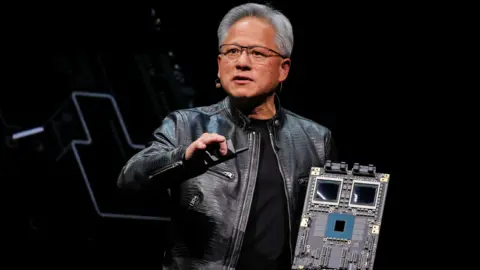
Semiconductor Leaders Cede 15% of China Chip Revenues for Export Access
In a landmark development underscoring the escalating technology rivalry between Washington and Beijing, US chip giants Nvidia and AMD have reached a unique agreement with the US government. In exchange for export licenses for their most advanced AI chips to Chinese customers, each company will remit 15% of their China-derived revenues from specified chip sales directly to the US Treasury.
This deal comes amidst tightening US export controls over semiconductor technology, with authorities scrambling to balance national security interests against the interests of American technology companies seeking to retain global market share.
The Chips at the Center of Tension: Nvidia’s H20 and AMD’s MI308
Nvidia’s H20, specifically engineered for Chinese clients after the Biden administration’s 2023 imposition of AI chip restrictions, and AMD’s MI308, are at the heart of this agreement. These chips, vital for data centers and artificial intelligence applications, had been withheld from the Chinese market after successive waves of US-imposed export controls due to concerns about their use in military and surveillance technologies.
Nvidia has said, “We follow rules the US government sets for our participation in worldwide markets,” adding that H20 shipments to China have been paused for months. However, the company remains hopeful that export controls will not cede America’s AI leadership: “America cannot repeat 5G and lose telecommunication leadership. America’s AI tech stack can be the world’s standard if we race.”
AMD has yet to publicly comment on the arrangement, while US officials continue to tread carefully, declining to offer public statements amid the sensitivity of negotiations.
Security Concerns Remain Front and Center
National security remains one of the primary drivers for strict controls on AI chip exports. Prominent former security officials have petitioned the current administration, warning that even restricted chips like the H20 “are potent accelerators” for Chinese AI, and could underpin technologies critical to military advancement, surveillance, and autonomous weapons.
In a letter to US Commerce Secretary Howard Lutnick, a group of 20 experts stressed that chips like the H20 are likely to be used beyond civilian sectors in China, highlighting the dual-use risks of advanced semiconductors.
Trade policy experts are divided over whether a revenue-sharing scheme truly addresses the core security issues. Deborah Elms of the Hinrich Foundation commented, “If you have a 15% payment, it doesn’t somehow eliminate the national security issue.” She made clear that the new payment mechanism is financial, not strategic, in its impact.
China Responds as Trade Tensions Simmer
Beijing has repeatedly accused Washington of “abusing export control measures, and engaging in unilateral bullying,” with the Ministry of Foreign Affairs stating its objections as the US continues to restrict high-tech exports.
This combative rhetoric comes even as there have been small signs of détente elsewhere. China has recently eased some controls on rare earth exports critical to the electronics supply chain, while the US has lifted certain restrictions on chip design tool companies operating in China—measures indicating a willingness on both sides to avoid outright economic decoupling.
Still, the chip sector remains a flashpoint, with China striving for greater self-sufficiency by ramping up investment in its domestic semiconductor industry, and the US striving to maintain its technological and economic edge through incentives and controls.
US Tech Investments Surge Amid “America First” Push
This landmark agreement coincides with a renewed push by the US administration to strengthen domestic technology capabilities. Apple recently pledged a further $100 billion in US investments, bringing its total to $600 billion over the next four years. Micron Technology, a leading memory chipmaker, is planning $200 billion in new US manufacturing facilities, including a massive new site in Idaho.
Nvidia, too, has announced ambitious plans to build American-made AI servers worth up to $500 billion and establish the first US-based AI supercomputers, underlining its critical position in both the global and national AI infrastructure race.
These actions are set against a backdrop of increasing political pressure for US technology firms to prioritize domestic investment and jobs, part of a broader “America First” agenda. The policy mix of incentives for reshoring advanced manufacturing and strict export controls is reshaping global supply chains and boardroom strategies across the sector.
Unresolved Issues Ahead of Tariff Truce Deadline
The timing of the Nvidia and AMD export license deal is significant. In May 2024, China and the US agreed to a 90-day pause on new tariffs as they attempt to negotiate a wider trade settlement. With the truce due to expire in August, the fate of billions in global supply chain flows hangs in the balance.
In the lead-up to the deadline, top trade officials from both countries have been meeting regularly, though the prospect of a further pause or even a comprehensive agreement remains uncertain. Should talks falter, new tariffs could hit technology hardware and semiconductors—a risk that threatens to reverberate across global markets.
The high-stakes environment is further complicated by ongoing leadership tensions at major US technology firms. Intel CEO Lip-Bu Tan has faced political pressure over alleged ties to China, highlighting the complicated personal and financial networks at the heart of the global tech industry.
The Path Forward: Uncertain but Unprecedented
The new 15% revenue-sharing arrangement between Nvidia, AMD, and the US government is “unprecedented,” according to Charlie Dai of Forrester Research. “The arrangement underscores the high cost of market access amid escalating tech trade tensions, creating substantial financial pressure and strategic uncertainty for tech vendors,” he noted.
While the move allows Nvidia and AMD to partially re-enter the world’s largest semiconductor market, it does so at a significant cost and under a unique form of regulatory oversight. The deal’s success may influence future US policy for technology exports, setting a precedent for balancing national security and commercial interests even as global competition intensifies.
Looking ahead, the broader landscape for global technology leadership, trade policy, and security controls remains highly dynamic. Both US and Chinese authorities are navigating an environment where economic, strategic, and technological priorities intersect in new and often untested ways.


