
Supreme Court Clears Path for Trump Administration to Dismantle Education Department, Allowing Mass Firings
By Maureen Groppe | USA TODAY | July 14, 2025
The United States Supreme Court delivered a landmark decision on Monday, July 14, 2025, granting the Trump administration the authority to proceed with the controversial dismissal of hundreds of Department of Education employees and ongoing efforts to significantly downsize or potentially dismantle the federal agency. The ruling, delivered in a brief, unsigned order, revealed a sharp ideological split among the justices, with the three liberal members strongly dissenting.
Presidential Authority vs. Congressional Mandate
This decision comes at a time of heightened scrutiny over the scope of presidential powers, particularly as former President Donald Trump, in his second term, pushes to fulfill campaign promises targeting federal oversight and bureaucracy. The core legal dispute revolved around whether the executive branch could unilaterally circumvent statutory requirements to maintain certain federal programs and functions by drastically reducing the agency’s staff.
Justice Sonia Sotomayor, authoring the dissent, condemned the ruling as a threat to the constitutional separation of powers. “The majority is either willfully blind to the implications of its ruling or naïve,” she wrote, warning that the decision gives the president sweeping authority to undermine laws enacted by Congress by “firing all those necessary to carry them out.”
With the Supreme Court declining to explain its reasoning, the decision stands as a major victory for the Trump administration—and sets a potentially far-reaching precedent regarding executive power over the federal workforce.
Background: The Road to the Supreme Court
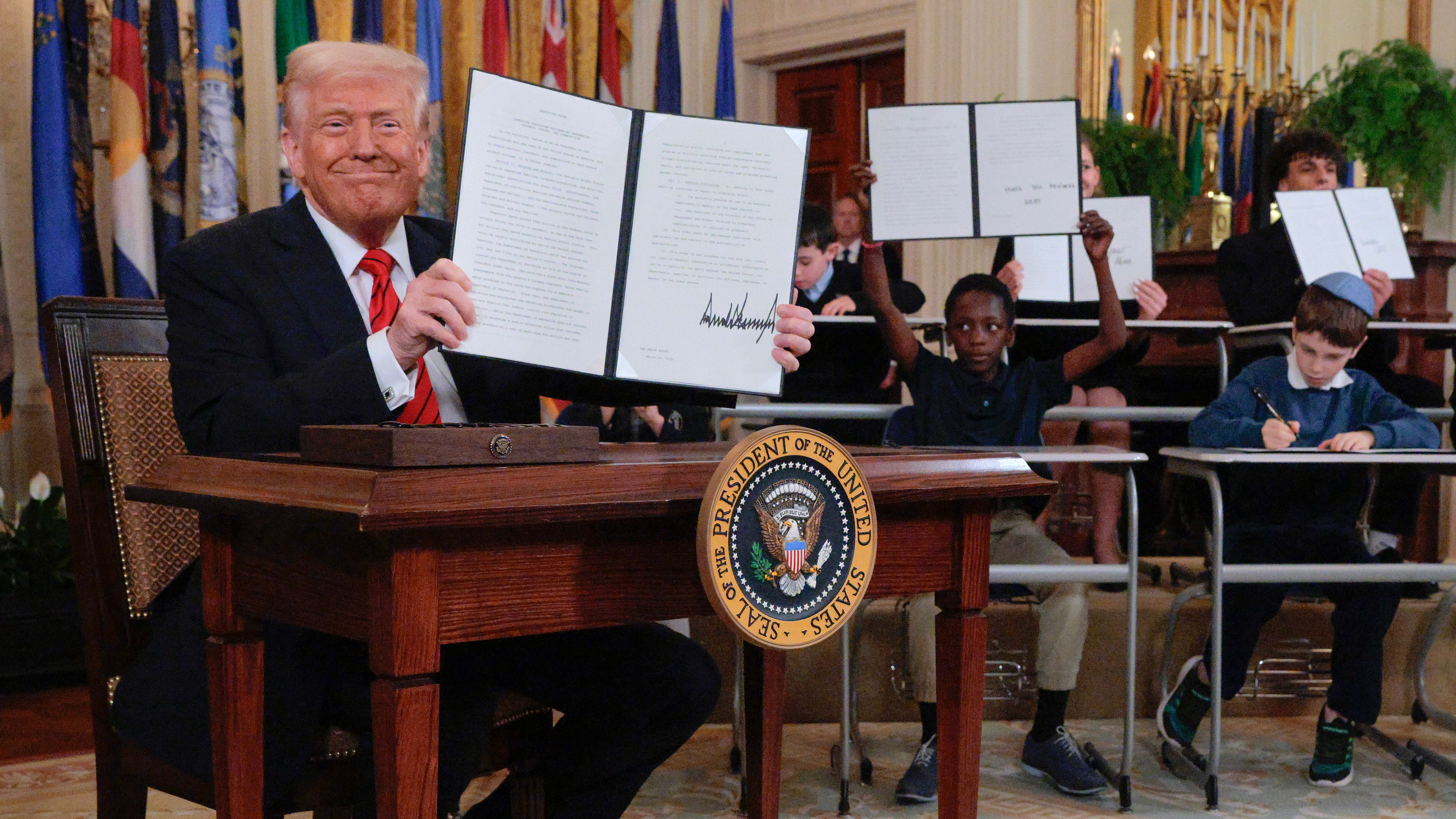
Since returning to the White House, President Trump and his administration have focused squarely on fulfilling conservative goals to reduce or eliminate the Department of Education—an agency established by Congress in 1979. In March 2025, President Trump issued an executive order directing Education Secretary Linda McMahon to “facilitate the closure of the Department of Education,” shifting numerous responsibilities to state governments and other federal agencies.
Under this plan, roughly half of the department’s workforce was slated for elimination through mass layoffs and voluntary buyouts—reducing the staff from 4,133 to approximately 2,183. Key federal functions, such as student loan administration and special education oversight, were scheduled for transfer to the Small Business Administration and the Department of Health and Human Services, respectively.
As the administration placed hundreds of employees on administrative leave and stopped their salaries in June, Democratic-led states, public school districts, and teachers’ unions sued. They argued that the moves hamstrung the department’s ability to carry out congressionally mandated services, including the allocation of federal student aid and enforcement of disability protections.
Lower courts initially sided with challengers. U.S. District Judge Myong Joun and the Boston-based 1st U.S. Circuit Court of Appeals ruled that Trump could not directly undermine Congressional intentions for the agency by rendering it nonfunctional. However, the Supreme Court’s latest action has now blocked these lower-court decisions, at least temporarily, allowing the cuts to proceed as legal battles continue.
Political and Educational Implications
The ruling has reignited fierce debates about the future direction of federal education policy. Trump and his supporters argue that decentralizing educational oversight will empower families, uphold states’ rights, and cut bureaucratic waste. “Today, the Supreme Court again confirmed the obvious: the President of the United States, as the head of the Executive Branch, has the ultimate authority to make decisions about staffing levels, administrative organization, and day-to-day operations of federal agencies,” said Secretary McMahon in a statement. She emphasized that the department would continue to perform essential education-related functions as required by law, even as it streamlines operations.
Critics, including education advocates, teacher unions, and legal experts, warn that these mass firings risk crippling federal oversight and imperil services vital to millions of students, especially those from disadvantaged backgrounds. New York and other state attorneys general have stressed that the loss of federal staff undermines critical programs, such as student aid eligibility certifications and the collection of education data used to distribute federal funding. The American Federation of Government Employees estimated that over $7 million per month was being spent paying the furloughed but inactive employees, a cost that lower courts previously justified as necessary to uphold legal and constitutional mandates.
Skye Peryman, president and CEO of the legal advocacy group Democracy Forward, vowed to “aggressively pursue every legal option” to ensure equitable access to education, stating, “It will be effectively impossible to undo much of the damage caused if these firings are allowed to stand while the courts deliberate.” Advocacy groups now look to Congress or new legal strategies for relief, while some Democrats have signaled intent to introduce legislation reasserting federal educational standards.
Separation of Powers and Federalism in the Spotlight
The dispute lays bare ongoing tensions between Congress, the presidency, and federal agencies. Constitutional scholars note that the case could have profound repercussions for the functioning of government—especially as similar arguments about presidential reorganization powers echo in other policy arenas, from environmental regulation to health care administration. The Justice Department has insisted that the executive branch must be able to determine its own staffing needs, particularly when Congress declines to act explicitly on reorganizational proposals. In contrast, the courts and many lawmakers maintain that the separation of powers doctrine requires meaningful Congressional involvement when statutory mandates are at stake.
This conflict has only intensified amid broader efforts by the Trump administration to streamline or shutter various federal agencies as part of its “America First” agenda. The Supreme Court’s resolution of this case may embolden further attempts to reduce the size and scope of the federal government through aggressive executive actions—raising the stakes for the 2026 midterms and future presidential campaigns.
Next Steps and Broader Implications
As litigation over the firings proceeds in lower courts, educational institutions, families, and state agencies face continued uncertainty about the future of federal support. Congressional leaders from both parties are now under pressure to clarify the legal limits of presidential authority over federal employment and to address the growing demand for education policy reform.
Meanwhile, advocacy groups are preparing new legal challenges, students and teachers brace for disrupted services, and state governments weigh their capacity to absorb new responsibilities. The Supreme Court’s decision exposes a pivotal moment in American governance, with ripple effects likely to impact federal administration, education funding, and the broader interface between Washington and the states for years to come.


