
Why Is Crypto Down Today? – July 8, 2025
Date: July 8, 2025
Market Snapshot: Global Crypto Prices Retreat
The cryptocurrency market woke up to another day of losses, with key digital assets and the wider market experiencing a broad pullback. As of early July 8, 2025, the global crypto market capitalization fell by 3.8% to $3.42 trillion. BTC (Bitcoin) was hovering at $108,322 (down 0.4%), while ETH (Ethereum) traded at $2,558 (down 0.3%). Trading volumes remained healthy but muted, with the total reaching $87.3 billion in the past 24 hours.
Most top 10 coins by market capitalization followed BTC and ETH in the red, with only slight changes signaling that a consolidative phase is underway. Notably, Dogecoin (DOGE) and Solana (SOL) showed steeper daily declines, down 2.5% and 1.3% respectively. In contrast, a few altcoins like Bonk (BONK) and Polygon (POL) bucked the trend with gains of 6.8% and 1.7% each.
What’s Driving the Downturn?
Several factors converged to put pressure on cryptocurrencies. The most pronounced trigger was global trade uncertainty sparked by reports that U.S. President Donald Trump had sent letters to allies threatening tariffs as high as 40% on imports, specifically targeting Japan and South Korea with 25% duties. These threats reignited fears of a new global trade war, rattling both traditional equity and crypto markets.
The U.S. stock market reflected sharper anxieties, with the S&P 500 losing 0.79%, Nasdaq-100 shedding 0.79%, and Dow Jones down by 0.94% in Monday’s session. Crypto’s correlation with risk assets tightened, although the selloff in crypto remained milder compared to equities, suggesting some decoupling and cautious optimism among digital asset investors.
Adding to the mixed sentiment, the Crypto Fear and Greed Index dipped from 52 to 50 over the day, trending closer to the fear zone, even as trading volumes and flows suggest ongoing institutional participation.
Institutional Flows and Crypto ETF Activity
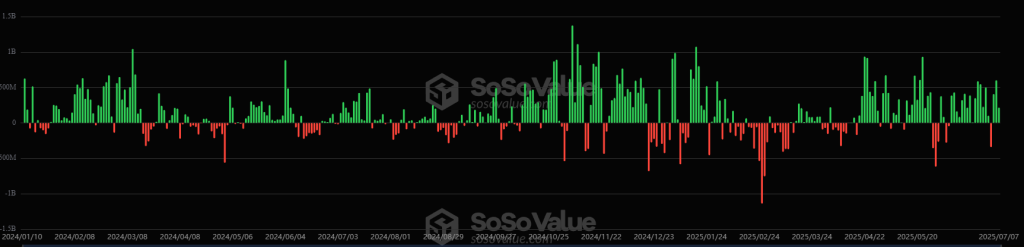
Despite price weakness, recent U.S. Bitcoin and Ethereum spot ETFs have continued to attract positive inflows—a key signal of underlying institutional appetite. On July 7, U.S. Bitcoin spot ETFs registered $216.64 million in net inflows, with BlackRock leading the charge at $164.64 million. Fidelity and Grayscale’s BTC fund also showed positive inflows, while Grayscale’s GBTC and Ark 21Shares saw outflows.
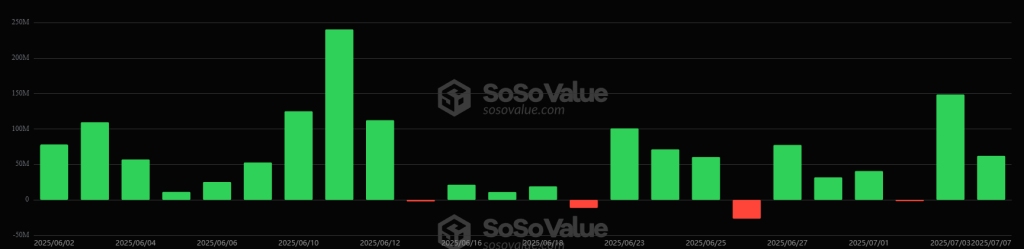
The story was similar for Ethereum, as U.S. ETH ETFs brought in $62.11 million, driven solely by BlackRock and Fidelity funds. These flows underscore the growing bridge between traditional finance and crypto markets, as ETFs provide regulated vehicles for large-scale capital allocation.
Broader Market Sentiment: Analysts Weigh In
“Price momentum may be strong, but muted volume and rising volatility suggest caution,” said James Toledano, Chief Operating Officer at Unity Wallet. He highlighted that while Bitcoin achieved a record June close above $107,100, the overall index readings remain in ‘neutral’ territory. This neutrality, Toledano suggests, arises from conflicting signals—strong institutional flows versus geopolitical uncertainty and mixed retail sentiment. “A lot of money is quite tentative right now as the world appears to be on a knife’s edge both geopolitically and macro-economically.”
Metrics such as options activity, Bitcoin dominance, and online search trends still reflect a market waiting for more decisive direction.
Evolving Industry & Regulatory Landscape
The weekend’s EthCC 2025 conference in Paris reinforced a growing convergence between traditional finance, DeFi, and Bitcoin. Alexei Zamyatin, co-founder of BOB and BitVM researcher, stated: “The lines between traditional finance, the DeFi ecosystem, and Bitcoin are blurring faster than ever.” Robinhood’s foray into tokenized equities and new modular rollup rollouts signal greater interoperability and innovation within capital markets.
Meanwhile, Ethereum’s co-founder Vitalik Buterin advocated for “copyleft licensing” as a way to recommit the crypto community to open-source values, amidst increasing competition and proprietary interests in the space.
The Dubai Financial Services Authority (DFSA) made headlines by formally approving the region’s first tokenized money market fund—the QCD Money Market Fund, jointly launched by Qatar National Bank and DMZ Finance. The product aims to bring traditional fixed-income instruments, such as U.S. Treasuries, on-chain, supporting use cases from stablecoin reserves to institutional liquidity solutions.
Further illustrating corporation-level adoption, Murano Global, a Nasdaq-listed hospitality and real estate firm, entered a $500 million equity agreement with Yorkville, with proceeds specifically earmarked for Bitcoin treasury purchases—an approach mirroring MicroStrategy’s ongoing crypto treasury strategy.
Price Levels and Sentiment to Watch
Bitcoin fluctuated within a tight range, bouncing between an intraday high of $109,056 and a low of $107,591. Ethereum followed a similar pattern, with a high of $2,581 and a low of $2,521 before partial rebounds. Market sentiment remains cautious, as the Fear and Greed Index moves sideways, and overall volatility persists.
Looking ahead, macroeconomic signals and policy actions—including further tariff announcements or easing geopolitical tensions—could significantly influence short-term market action. Leading analysts expect the current consolidation to persist, with possible dips, but generally anticipate overall improvement by the end of 2025 if trade tensions do not escalate further.
FAQ: Today’s Crypto Market Moves
- Why did crypto move with stocks today? — Both markets were affected by escalated trade talk and tariff threats from the U.S., with cryptocurrencies reacting as an increasingly mainstream asset class alongside equities.
- Is this price dip sustainable? — According to analysts, periodic corrections are expected in a consolidative market phase, but long-term prospects remain positive given sustained institutional flows and innovation headlines.
Investors are advised to monitor global trade developments, ETF inflow data, and emerging regulatory responses for signs of either renewed risk appetite or further caution.


