
Texas Democrats Rally Against Trump-Backed Redistricting as GOP Pushes for Five New Seats
By Gabby Birenbaum and Owen Dahlkamp
July 15, 2025
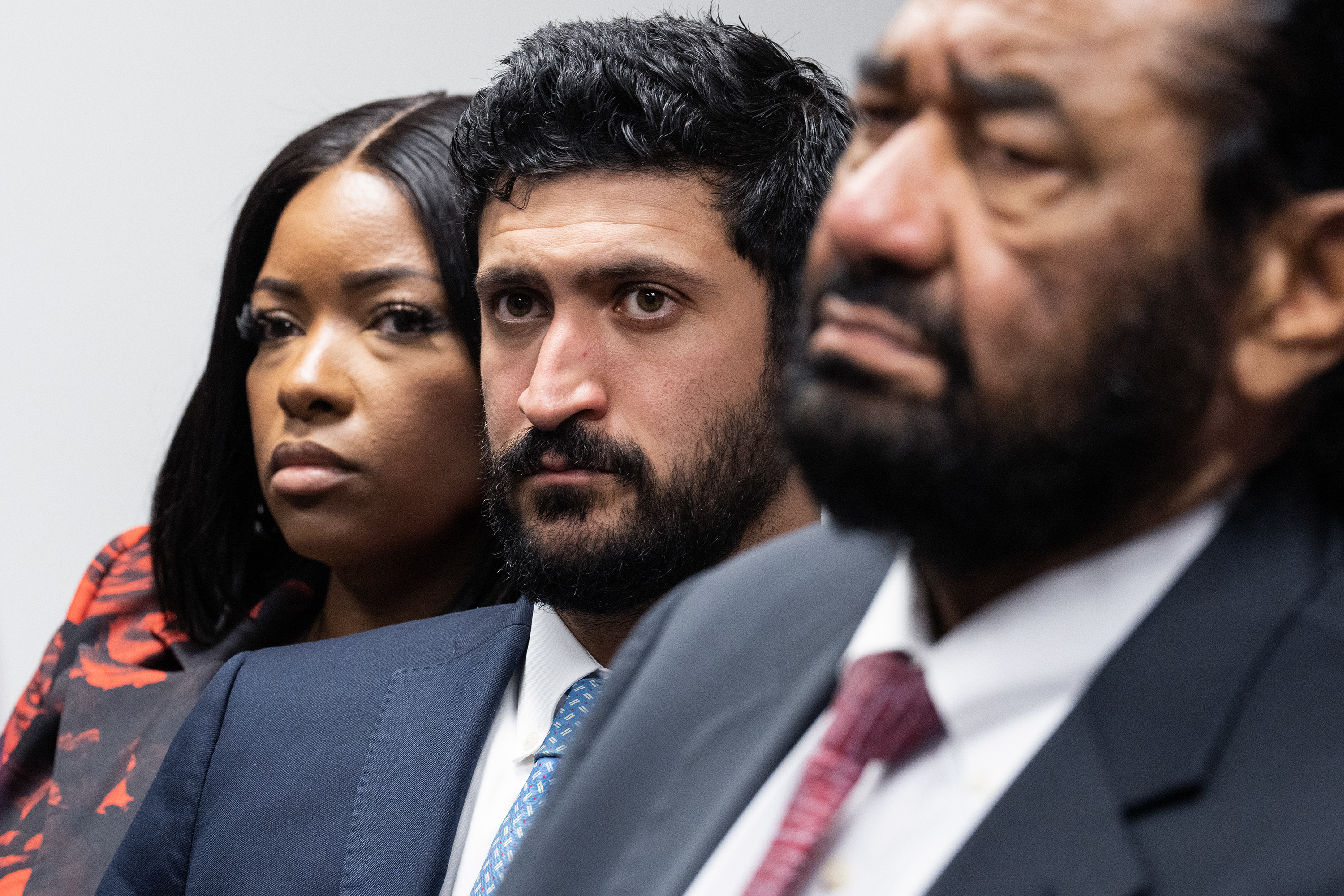
U.S. Reps. Jasmine Crockett, Greg Casar, and Al Green attend a press conference on redistricting, July 15, 2025. Credit: Tom Williams/CQ Roll Call/Sipa USA via REUTERS
The Redistricting Showdown
Political tensions are rising in Texas as the state prepares for a special legislative session to tackle the controversial process of redistricting, with enormous stakes for the balance of power in Congress. President Donald Trump, seeking to solidify Republican control ahead of the 2026 midterms, is pressing Texas Republicans to redraw congressional lines to net as many as five additional GOP seats—a move sharply denounced by the state’s Democratic congressional delegation as an assault on voter representation and democracy.
Meeting at the Democratic National Committee offices, U.S. Reps. Jasmine Crockett (D-Dallas), Greg Casar (D-Austin), and Al Green (D-Houston) joined House Democratic leaders to sound the alarm about what they describe as a brazen GOP plan to “mute” the voices of minorities and Democratic voters in Texas, a state with a complex history of racially contentious map drawing.
Trump’s Redistricting Gambit
The push for mid-decade redistricting was greenlit after Governor Greg Abbott placed it on the upcoming special session’s agenda, responding in part to a recent Department of Justice letter addressing voting rights and coalition districts. President Trump, eager to expand his party’s thin House majority, publicly bragged that a new map could give Republicans “three to five more seats” in Texas alone—and signaled that other GOP-led states might follow suit. Trump’s political team has floated strategies to shift Republican voters from safely red districts into competitive or Democratic-leaning ones, potentially flipping the congressional delegation from its current 25-13 GOP advantage even further to the right.
Political observers note that the timing is no coincidence. Historically, redistricting is tied to the decennial census, but mid-decade changes have increasingly become a tool for power consolidation. The last instance came in the 2024 cycle, when North Carolina’s Republican majority redrew their map, costing Democrats three House seats. In Texas, the likely shift could yield nearly 80% Republican control of the congressional delegation—even though the 2024 presidential contest saw Democratic nominee Kamala Harris win 42% of the state vote.
Democratic Response: Limited Tools, High Stakes
With the Texas Legislature firmly in GOP hands, Democrats in Congress and Austin have little institutional leverage to block or minimize the impact of a Republican-engineered map. Voter power remains a flashpoint, as Democrats emphasize the threat to communities of color, arguing the map could continue the state’s long pattern of Voting Rights Act violations. Representative Jasmine Crockett accused GOP counterparts of striving to “make sure that they mute our voices,” warning such tactics were designed for lasting Republican dominance.
Amid their limited legislative options, Democratic strategies include:
- Lobbying blue states to implement similarly partisan redistricting in retaliation, hoping to offset GOP gains at the national level.
- Encouraging state lawmakers to flee Austin, breaking the legislative quorum to stall passage—a dramatic, if risky, maneuver previously attempted in 2021 during contentious voting reform battles.
- Preparing a robust legal challenge, as has occurred after nearly every Texas redraw since passage of the Voting Rights Act in 1965. The current Texas map, drawn in 2021, is already under federal litigation.
House Minority Leader Hakeem Jeffries (D-New York) derided Texas Republicans as “acting like political punks” in ceding to Trump and warned of potential blowback, invoking the risks of a “dummymander”—a term for gerrymanders that overreach and ultimately favor the opposition in future elections.
The Risk of Overreach and Historical Context
Political experts say that aggressive gerrymanders can lay the groundwork for future upsets if demographic or electoral tides shift. In 2018, Texas Democrats seized advantage during Trump’s midterm cycle, flipping two U.S. House seats and making inroads in the state legislature. This underscores the possibility that overextending new GOP districts might expose incumbents to unexpected vulnerability if national dynamics turn against Republicans.
Republican voters have become more efficient in their vote distribution, buoyed by 2024 increases among historically Democratic-leaning Hispanic voters. Senator John Cornyn cited this trend as a rationale for the redistricting effort. However, Republican Rep. Chip Roy (R-Austin) expressed concern about redrawing districts based on 2020 census data, given Texas’s explosive population growth and demographic changes since then—risking maps quickly becoming outdated or litigated.
Blue State Countermoves and Party Strategy
As Democrats scramble for leverage, discussions have intensified over pushing Democratic-controlled states like California and New York to redraw lines in their own favor—a practice often decried by voting rights advocates but, in this context, seen as a form of political deterrence. California Governor Gavin Newsom has hinted at possible retaliation, though as of mid-July, no blue state has formally moved forward with such a plan.
Meanwhile, the Democratic Congressional Campaign Committee has promised to target any newly vulnerable Texas Republicans with well-funded campaigns. “We will do everything that we can do in Texas and beyond to respond,” emphasized Leader Jeffries, committing to contesting competitive seats and boosting turnout among marginalized communities—a strategy that proved fruitful in past midterm waves.
Legal and Civil Rights Challenges
Legal challenges loom large over any Texas redistricting effort. The Justice Department has pressed Governor Abbott and Attorney General Ken Paxton to address the rights of coalition districts—those where multiple minority groups combine to form a majority—under new court precedents that could upend traditional mapmaking rules. Democratic Rep. Sylvia Garcia (D-Houston) has called the state’s moves an “attempt to silence the voices of communities of color who have powered progress in Texas for decades.”
Litigation is expected to follow quickly after any new map’s passage. Every Texas map in recent decades has been challenged in federal court, with at least one found in violation of the Voting Rights Act per redistricting cycle since 1965. Currently, the 2021 map remains before the courts, with a verdict on alleged racial gerrymandering pending as of July 2025.
Looking Ahead: National Stakes, Local Battles
The looming redistricting battle in Texas is emblematic of broader national struggles over voting rights, partisan gerrymandering, and fair representation. As partisan control of the U.S. House hangs in the balance—Republicans currently hold a slim majority of 219-216—the outcome in Texas could prove decisive in the 2026 midterms, shaping the future direction of federal policy and the power of diverse communities within America’s second largest state.
With legal battles, demographic shifts, and growing national attention converging, the Texas redistricting fight is far from over. For Texas Democrats and their allies, the coming weeks could define both the state’s political landscape and the national conversation on democracy itself.


